



The Story
On November 4, 2026, Vishay Intertechnology reported results for its third quarter, which ended October 3. Vishay isn’t a household name. It makes the tiny parts inside almost every electronic product: resistors, capacitors, diodes and power chips. They go into cars, factory equipment, computers and phones.
It was a big quarter. Revenue was $978.9 million, the highest in the company’s history. That’s up 24% from $790.6 million a year earlier. Gross margin rose from 19.5% to 25.5%.
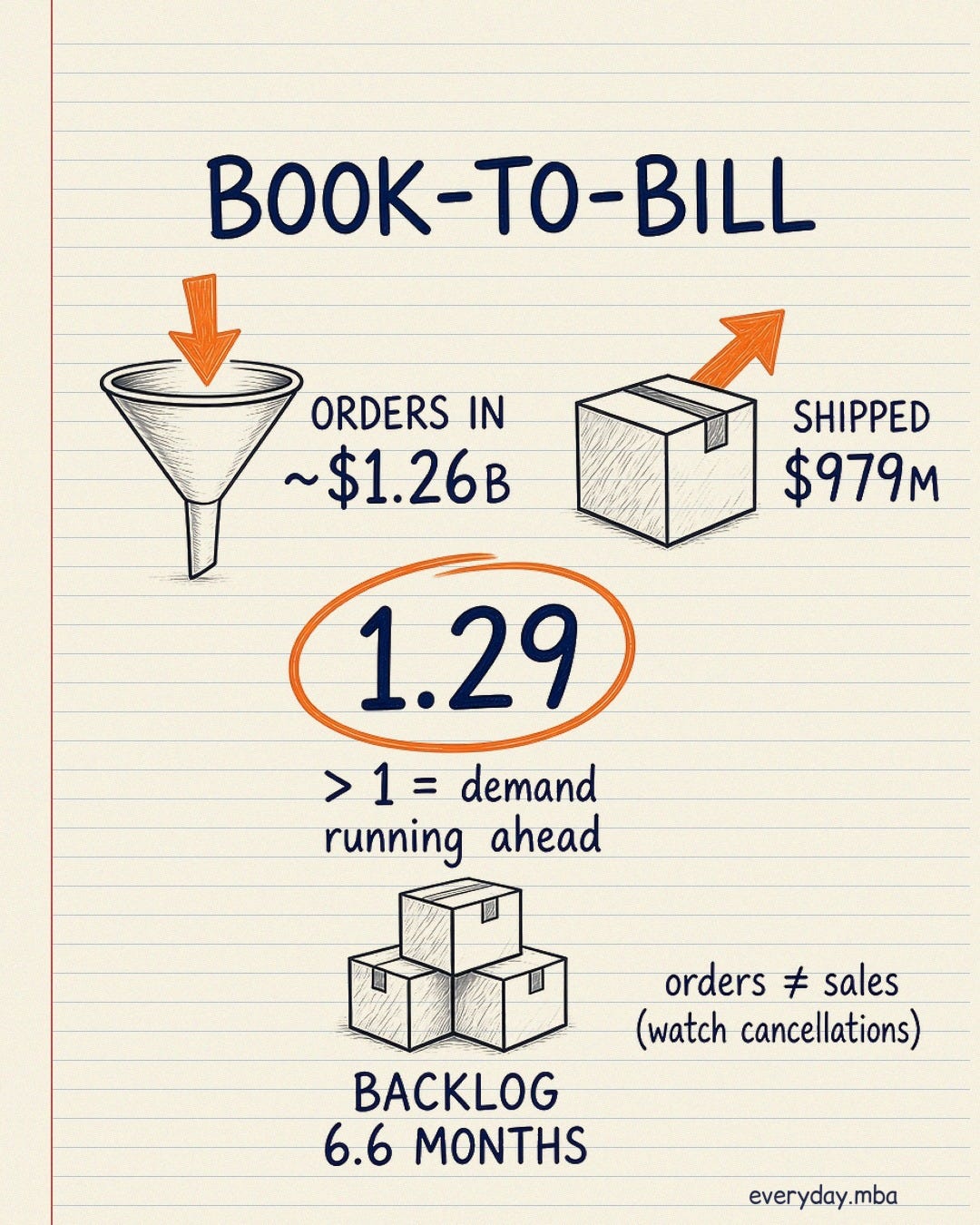
But the most interesting number in the release isn’t revenue. It’s one line in the highlights: “book-to-bill of 1.29.”
Vishay also said its backlog at quarter end was 6.6 months. And it told investors to expect fourth-quarter revenue of about $990 million, give or take $15 million.
The Lesson
Book-to-bill compares two things. New orders that came in during the quarter (bookings). And products shipped and billed during the quarter (billings, which is basically revenue).
Book-to-bill = new orders ÷ revenue.
A ratio of 1.0 means orders came in exactly as fast as the company shipped. Above 1.0, orders are coming in faster than the company can ship. Below 1.0, the company is shipping more than it’s getting in new orders.
Vishay’s 1.29 means that for every $1.00 of product it shipped, customers ordered about $1.29. Do the math on $978.9 million of revenue and that’s roughly $1.26 billion of new orders in one quarter. About $280 million more came in than went out.
That gap doesn’t disappear. It goes into the backlog, the pile of orders waiting to be filled. Vishay says its backlog now equals 6.6 months of sales. Customers are waiting longer and ordering further ahead.
Both sides of the business pointed the same way. Semiconductors came in at 1.28. Passive components, like resistors and capacitors, came in at 1.31. When every product line is above 1, demand isn’t just one hot customer.
That’s why investors watch this number. Revenue tells you what happened last quarter. Book-to-bill hints at what’s coming next. Above 1 for a few quarters usually means revenue has room to grow.
The catch: orders aren’t sales. Some customers order more than they need when parts get scarce, hoping to get in line early. If supply catches up, some of those orders can get pushed out or canceled. A high book-to-bill can be real demand, or partly panic buying. So it’s a signal, not a promise.
And notice the guidance. Orders ran far ahead of shipments, yet Vishay expects only about 1% more revenue next quarter. Why? Revenue is limited by how much the company can make and ship, not just by how much customers want. That’s why its CEO talked about adding “incremental capacity.”
How to Use It
1. Find the ratio. Chipmakers, parts suppliers, and equipment companies often report book-to-bill. If they don’t, look for orders and backlog.
2. Read it against 1.0. Above 1 means demand is outrunning shipments. Below 1 means the backlog is shrinking.
3. Watch the trend. One quarter at 1.29 is good news. Three quarters in a row is a stronger signal. A drop back toward 1 tells you the rush is cooling.
4. Check the backlog. Book-to-bill above 1 should make the backlog grow. If it doesn’t, ask about cancellations.
5. Ask about capacity. Lots of orders don’t help if the company can’t build fast enough. Look at what management says about new factories and lead times.
6. Use it at work. Track your own version: new deals signed versus work delivered each month. If signings run ahead, you need more people or capacity soon. If deliveries run ahead, your pipeline is drying up.
Sources
1. Vishay Intertechnology, “Vishay Intertechnology Reports Third Quarter 2026 Results,” press release, November 4, 2026. https://ir.vishay.com/news-releases/news-release-details/vishay-intertechnology-reports-third-quarter-2026-results