



The Story
On October 23, 2026, SLB, one of the world’s largest oilfield services companies, reported results for its third quarter ended September 30. SLB doesn’t pump oil itself. It sells the drilling, equipment, software and services that oil and gas producers use to find and pull it out of the ground.
Revenue came in at $9.45 billion. SLB reports every key number two ways. Compared with the second quarter, revenue rose 5%. Compared with the third quarter of 2025, it rose 6%.
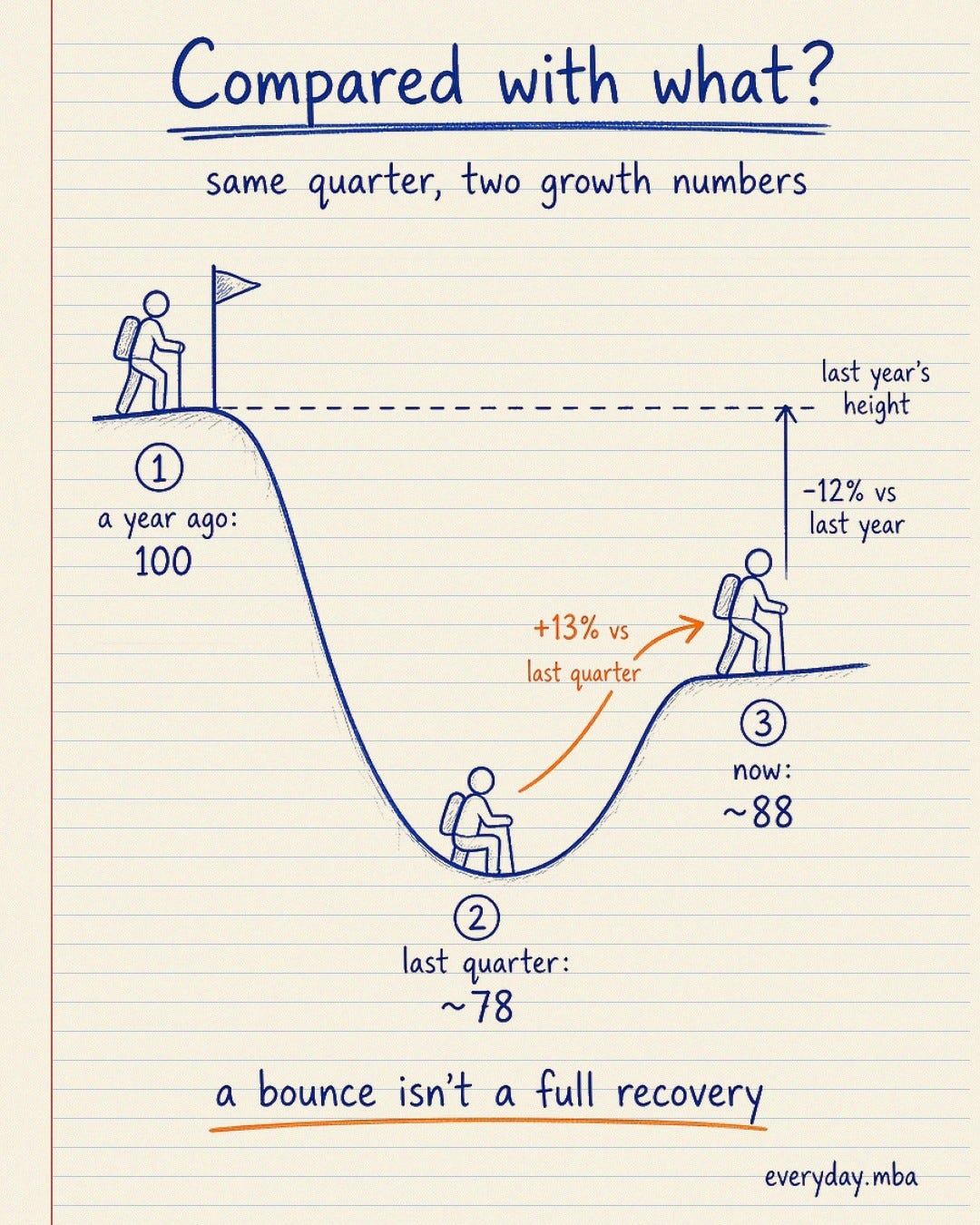
The most interesting gap was in the Middle East. Middle East revenue jumped 13% from the second quarter. SLB said that reflected a “rebound in activity following operational disruptions related to the regional conflict in the prior quarter.” Activity picked up in Iraq, Kuwait, Oman, Saudi Arabia, Qatar and the United Arab Emirates, though some countries saw renewed disruptions in the last weeks of the quarter.
But compared with a year earlier, Middle East revenue was down 12% on a pro forma basis, also because of conflict-related disruptions. Same region, same quarter, two very different stories.
North America showed a different pattern. Revenue there rose 7% from the second quarter, helped in part by more drilling in Canada after the “spring breakup.” That is the stretch each spring when thawing ground makes roads too soft for heavy rigs, so Canadian drilling slows every spring and picks back up in the summer.
The Lesson
Growth always means growth compared with something. The two most common choices are the last quarter (called sequential, or quarter over quarter) and the same quarter a year earlier (year over year). Each answers a different question.
Sequential growth tells you about direction right now. Is the business speeding up or slowing down? It catches turns early. But it is easily fooled by seasons, like Canada’s spring thaw, and by bounces off a bad quarter.
Year-over-year growth compares a quarter with the same season a year ago, so seasonal swings cancel out. It tells you whether the business is actually bigger than it was. But it reacts slowly, and it can be fooled by anything that changed the base, such as an acquisition.
SLB’s Middle East numbers show why you need both. Put the year-ago quarter at 100. Being down 12% puts this quarter at about 88. Being up 13% from the second quarter means the second quarter was about 78 (88 divided by 1.13). So the region fell roughly 22% below last year’s level, then won back less than half of that gap.
That’s the math of a hole. A 22% drop needs about a 28% gain just to get back to even. A 13% rebound looks strong in a headline, but the year-over-year number tells you the recovery isn’t finished.
The company-wide year-over-year figure needs a second look, too. SLB bought ChampionX in July 2025, so the year-ago quarter held only two months of that business while this quarter held three. SLB says that, excluding the acquisition, revenue grew 2% year over year, not 6%.
How to Use It
1. Always ask “compared with what?” A growth number without its baseline is only half a fact.
2. Use sequential growth for momentum. It shows turns early. Then check whether the last quarter was unusually weak or the business is seasonal.
3. Use year-over-year growth for size. It cancels out seasons and shows whether the business really grew. Check for acquisitions or one-off events in the base.
4. Chain the two numbers. If you have both, you can back into how deep the dip was and how much ground is left to recover.
5. Apply it to your own work. If your sales are up 20% from a slow January, compare them with last February before you celebrate.
Sources
1. SLB, “SLB Announces Third-Quarter 2026 Results,” news release, October 23, 2026. https://investorcenter.slb.com/news-releases/news-release-details/slb-announces-third-quarter-2026-results/
2. SLB, Form 8-K, filed October 23, 2026 (SEC EDGAR). https://www.sec.gov/Archives/edgar/data/87347/000119312526429435/0001193125-26-429435-index.htm
3. SLB, Exhibit 99 to Form 8-K (third-quarter 2026 earnings release, including revenue by geographical area and division), filed October 23, 2026 (SEC EDGAR). https://www.sec.gov/Archives/edgar/data/87347/000119312526429435/d151271dex99.htm