



The Story
On November 10, 2026, Sea Limited, the Singapore company behind the Shopee shopping app, the Garena games business, and a fast-growing lending business called Monee, reported its third quarter. Total revenue rose 43% to $8.6 billion, about $500 million more than analysts expected. Shopee posted record profit.
Earnings per share, at 78 cents, came in well short of the nearly $1 a share analysts were looking for. The stock fell almost 9% before the market opened, was up more than 9% at its high for the day, and closed down 1.5% at $76.80.
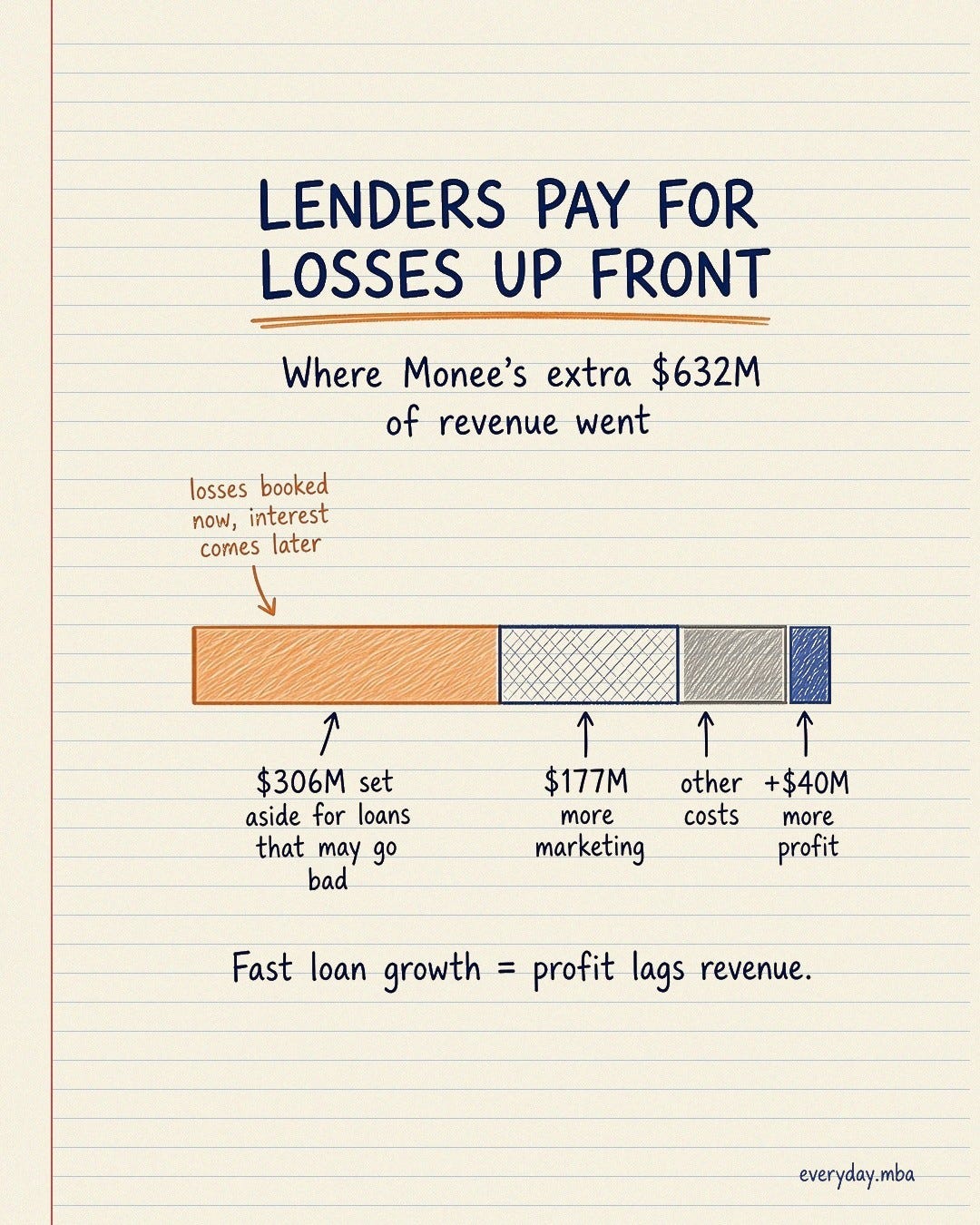
A big part of the gap sits inside Monee. Monee makes consumer and small-business loans in Southeast Asia and Latin America. Its loans outstanding grew 60% from a year earlier to $12.6 billion. Its revenue grew 64%, from $990 million to $1.62 billion. That is $632 million of new revenue in one year.
Monee’s profit (adjusted EBITDA) rose only 15.5%, from $258 million to $298 million. That is about $40 million more profit on $632 million more revenue.
The biggest reason is one line: the provision for credit losses. Monee set aside $679 million for loans it expects will not be paid back, up from $372 million a year earlier. That increase of $306 million ate almost half of the new revenue. Higher marketing took another $177 million.
The Lesson
When a company lends money, it doesn’t wait for borrowers to stop paying before it counts the losses. Under US accounting rules, which Sea follows, a lender has to estimate the losses it expects over the whole life of a loan and record that cost when the loan is made.
The revenue works the other way. Interest and fees come in over the months the loan is outstanding.
So a lender’s costs arrive up front and its revenue arrives over time. Picture lending $100 that you expect to lose $5 on. You book the $5 expense today. The interest shows up over the next year.
Now grow the loan book 60% in a year. Every month, you are booking the expected losses on a big wave of brand-new loans, while only collecting part of the interest those loans will eventually earn. Profit lags revenue. The faster you grow, the bigger the lag. If growth slows, the same math works in reverse and profit can jump even if revenue growth cools.
That is why a lender’s profit margin can shrink during a growth spurt without anything going wrong. Monee kept about 26 cents of profit per dollar of revenue a year ago. This quarter it kept about 18 cents.
But the provision is also where trouble shows up first. Monee’s provision grew 82% while its loans grew 60%, so growth alone doesn’t explain all of it. Its share of loans more than 90 days past due rose to 1.3% from 1.1%. Still low, but moving the wrong way. The job is to tell the two apart: losses that come with growth, and losses that come from weaker borrowers.
How to Use It
1. Put the provision next to loan growth. If provisions grow roughly in line with the loan book, growth is probably the story. If they grow much faster, look harder at credit quality.
2. Track the late-payment rate. The share of loans past due is the early warning. A small move up is worth watching, and a steady climb is a problem.
3. Expect thin early profits from fast-growing lenders. Expected losses get booked up front, so a lender that is growing quickly will look less profitable now than it will once growth slows.
4. Apply it to anything you sell on credit. If your company offers payment plans or net-60 terms, the cost of customers who never pay starts the day you extend the credit, not the day the invoice goes bad.
5. Ask what profit looks like at a steady size. Before judging a lender’s margins, ask what they would be if the loan book stopped growing for a year.
Sources
1. Sea Limited, “Sea Limited Reports Third Quarter 2026 Results” (Exhibit 99.1 to Form 6-K), November 10, 2026. https://www.sec.gov/Archives/edgar/data/1703399/000119312526455420/d17880dex991.htm
2. Investing.com, “Sea Limited shares tumble 9% on third quarter earnings miss,” November 10, 2026. https://www.investing.com/news/earnings/sea-limited-shares-tumble-9-on-third-quarter-earnings-miss-93CH-5014907
3. Yahoo Finance, “Sea Limited (SE) Stock Historical Prices & Data” (November 9 close $77.96; November 10 high $85.16, close $76.80). https://finance.yahoo.com/quote/SE/history/
4. 24/7 Wall St., “Sea Limited Q3 2026: Revenue Rises 43%, Credit Costs Bite EPS,” November 10, 2026. https://247wallst.com/cards/sea-q3-2026-earnings-se-01m73n7fcd7ky9ja0qzwjwxr0t
5. Board of Governors of the Federal Reserve System, “Financial Accounting Manual, Chapter 8. Special Topics” (section 81.02, Recognizing an Allowance for Credit Losses). https://www.federalreserve.gov/aboutthefed/chapter-8-special-topics.htm