


The Story
On October 20, 2026, RTX, the aerospace and defense company that owns Pratt & Whitney, Collins Aerospace and Raytheon, reported results for its third quarter ended September 30. Sales rose 11% to $25.0 billion. Net income rose 35% to $2.58 billion, from $1.92 billion a year earlier. RTX reported a record backlog of $340 billion and raised its full-year outlook. Investing.com reported that the shares rose more than 2% in premarket trading.
One line in the summary table went the other way. Operating cash flow, the cash the business brought in from running itself, fell 38% to $2.87 billion, from $4.64 billion. Subtract $749 million spent on plants and equipment, and free cash flow came to $2.12 billion, down 47% from $4.03 billion.
So profit went up by $665 million while free cash flow went down by $1.9 billion. A year ago, RTX turned every $1 of profit into about $2.10 of free cash flow. This quarter, each $1 of profit became about 82 cents.
The cash flow statement shows where the money went. It starts with net income, then adjusts for cash that moved differently from profit. Three lines stand out. Contract liabilities, which are customer advances and bills sent ahead of the work, shrank by $980 million this quarter after growing by $986 million in the same quarter last year. That swing alone is almost $2 billion. Inventory rose by $543 million, after falling by $182 million a year earlier. And the money customers owed RTX rose by $717 million, compared with $351 million a year earlier.
The release doesn’t explain each line. But the direction is clear: more of this quarter’s profit sat in parts, unfinished work and unpaid bills instead of the bank.
Zoom out and the picture changes. For the first nine months of 2026, free cash flow was $6.31 billion, up 33% from $4.75 billion, and RTX raised its full-year free cash flow target to $9.0 to $9.2 billion.
The Lesson
Net income and cash are not the same thing. Accounting records revenue when it is earned and costs when they are incurred, not when money changes hands. Free cash flow is simpler: cash from operations, minus what you spend on the equipment and buildings that keep the business running and growing.
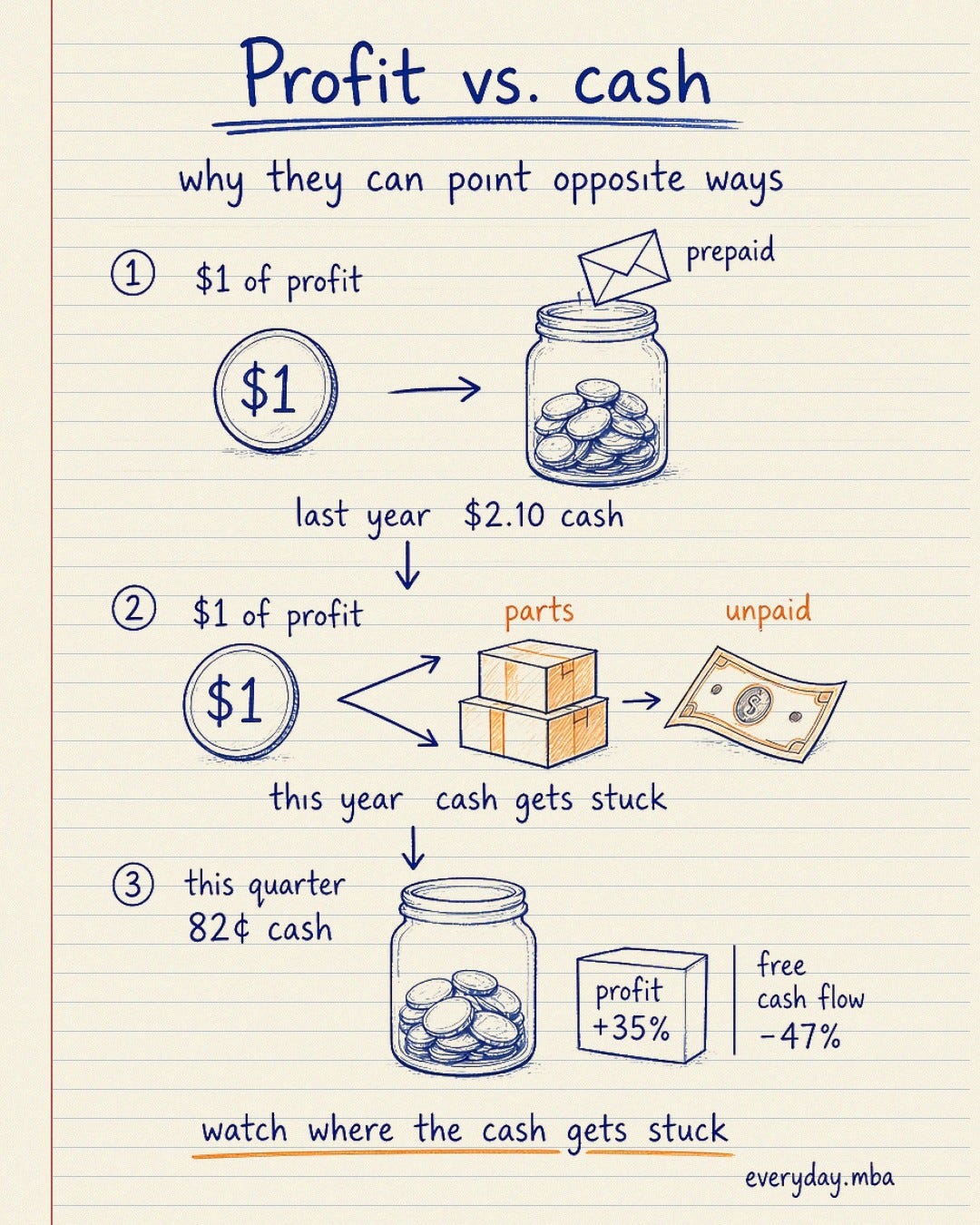
The gap between the two is mostly working capital: money tied up in inventory, in bills customers haven’t paid yet, and in prepayments you’ve already collected and now owe work against. Parts built ahead of shipment cost cash today and turn into profit later. When a customer prepaid last year, the cash arrived then. This year’s work on that order earns profit but brings in no new cash.
That’s why one quarter can mislead in either direction. RTX’s third quarter last year looked unusually strong partly because customer advances jumped. This year’s looks weak partly because they shrank. Over nine months, RTX turned about 93 cents of each $1 of profit into free cash flow, a steadier read.
The warning sign is a pattern, not a quarter. If profit keeps rising and cash keeps lagging, quarter after quarter, something is stuck: customers paying slower, inventory piling up, or sales booked too early. Cash is harder to dress up than earnings, which is why lenders and investors watch it so closely.
How to Use It
1. Put profit and free cash flow side by side. Divide free cash flow by net income. Over a full year, a number near 100% is a good sign for many businesses. Far below it, year after year, needs an explanation.
2. Read the “change in” lines. On the cash flow statement, receivables, inventory and customer advances show where cash got stuck or freed up. At RTX, the swing in customer advances alone was bigger than the entire $1.8 billion drop in operating cash flow.
3. Look at longer stretches. Check the year to date or the last four quarters, and ask whether last year’s quarter was unusual. RTX’s quarter was down 47%; its nine months were up 33%.
4. Know which cash is borrowed from customers. Advances make cash look great when they grow and weak when they shrink, even if the business is fine. Separate that timing from real changes in demand.
5. Use it in your own work. Profit doesn’t pay salaries; cash does. If you run a team or a business, track when customers pay and how much stock you hold, not just what you sell. Fast growth can eat cash before it makes any.
Sources
1. RTX Corporation, “RTX Reports Q3 2026 Results,” news release with financial tables (via PR Newswire), October 20, 2026. https://www.prnewswire.com/news-releases/rtx-reports-q3-2026-results-302913803.html
2. RTX Corporation, Form 8-K (Items 2.02 and 9.01), filed October 20, 2026 (SEC EDGAR). https://www.sec.gov/Archives/edgar/data/101829/000010182926000030/0000101829-26-000030-index.htm
3. RTX Corporation, Exhibit 99 to Form 8-K (third quarter 2026 earnings release, including statement of cash flows and free cash flow reconciliation), filed October 20, 2026 (SEC EDGAR). https://www.sec.gov/Archives/edgar/data/101829/000010182926000030/a2026-10x208xkerexhibit99.htm
4. Investing.com (via Yahoo Finance), “RTX stock climbs on strong earnings beat and raised outlook,” October 20, 2026. https://finance.yahoo.com/markets/stocks/articles/rtx-stock-climbs-strong-earnings-113444415.html