


The Story
On October 8, 2026, PepsiCo reported results for the 12 weeks that ended September 5. Net revenue rose 5.6% to $25.3 billion. Organic revenue, which strips out acquisitions, divestitures, and currency translation, rose 3.1%—the company’s fastest organic growth since late 2023. Core earnings per share, PepsiCo’s preferred profit measure, came in at $2.34, up 2% and a few cents ahead of what analysts expected. The headline looked fine.
Open the segment table and the picture changes. PepsiCo’s international businesses grew organic revenue 8%, the fastest clip since early 2024 and the 22nd straight quarter of at least mid-single-digit organic growth. International Beverages Franchise rose 7% organically, Europe/Middle East/Africa 9%, Latin America Foods 6%, and Asia Pacific Foods 9%. Core operating profit for the international group rose 16%, and its core margin expanded by more than a full point. Year to date, international already accounts for 41% of PepsiCo’s net revenue and 45% of its core segment operating profit.
North America told a different story. PepsiCo Foods North America—Frito-Lay and Quaker—posted flat organic revenue. Its core operating profit, in constant currency, fell 12%, and its core margin compressed by 280 basis points as affordability investments and higher marketing outweighed volume gains. PepsiCo Beverages North America reported a 5% sales rise, but that was almost entirely acquisitions made in 2025. Organically, beverage revenue was flat, and volume fell 2%. CEO Ramon Laguarta said the North America business “performed below our expectations.” CFO Steve Schmitt was blunter about the timeline: the turnaround “is taking more time than we planned,” and North America margins will stay under pressure in the fourth quarter.
That gap showed up in the outlook. PepsiCo kept organic revenue guidance near 3% and nudged full-year net revenue growth to about 6%. It cut core constant-currency EPS growth to 1%–2%, from the low end of 4%–6%, and cut core EPS growth to 2.5%–3.5%, from the low end of 5%–7%. Shares still rose about 2% the morning of the report, according to CNBC, because the beat landed and international kept carrying the load.
The Lesson
A company-wide growth rate is an average. When one region is booming and another is stuck, the average can look healthy while the stalled market is still the problem that sets next year’s profit. The tool to see that is the segment breakdown—revenue and profit by geography or product line—not the consolidated line at the top of the release.
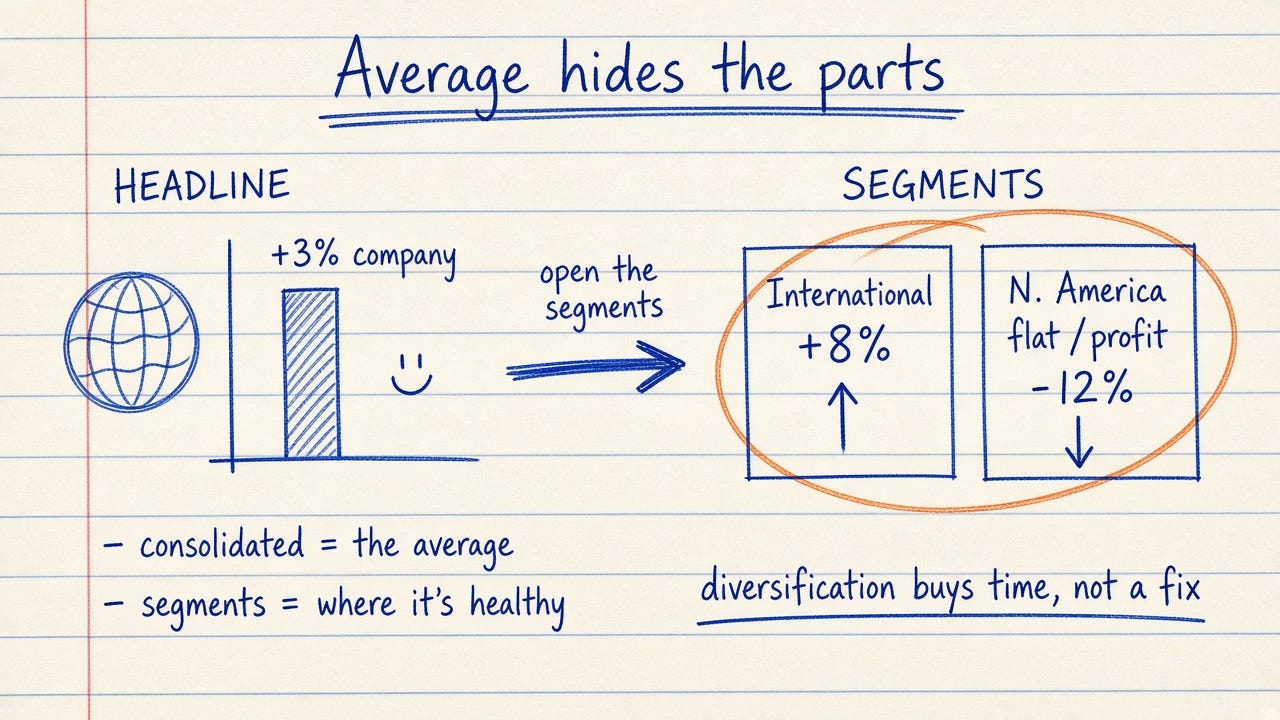
Geographic diversification is the strategy that makes this possible. Spreading sales across countries reduces the chance that one weak market sinks the whole company. PepsiCo’s international engine is doing exactly that: it is large enough (nearly half of core segment profit) and growing fast enough (8% organic) to keep the consolidated number moving even as the home market stalls. Diversification buys time. It does not fix the weak region by itself.
The risk is mistaking the portfolio’s rescue for a turnaround in the problem market. PepsiCo’s guidance cut is the tell. Revenue can hold because overseas demand is strong; profit guidance falls because North America margins are still under pressure and the company plans to spend more on innovation and marketing to fix it. If you only read “organic revenue up 3.1%,” you miss why management just lowered the earnings bar. The same pattern shows up anywhere a strong division masks a weak one—by country, by brand, or by customer segment. The consolidated number answers “how did we do overall?” The segments answer “where is the business actually healthy?”
How to Use It
1. Open the segment table before you trust the headline. Find revenue and operating profit by geography or division. Ask which parts are growing and which are carrying the average.
2. Compare the weak region’s share of sales to its share of profit. PepsiCo’s international arm is 41% of revenue and 45% of core segment profit year to date. A region that is smaller but more profitable (or the reverse) changes how much trouble a stall can cause.
3. Watch guidance, not just the beat. A company can beat this quarter and still cut next quarter’s profit outlook when the weak region’s fix will cost margin. That is the signal that the average is papering over the problem.
4. Treat diversification as time, not a cure. If your own business has one strong channel covering a weak one, use the strong side’s cash to fund the fix—and set targets for the weak side on its own, not against the blended average.
Sources
1. PepsiCo, “PepsiCo Reports Third-Quarter 2026 Results,” press release (Exhibit 99.1 to Form 8-K), October 8, 2026. https://investors.pepsico.com/docs/pepsico-5v9wci20/media/Files/investors/q3-2026-earnings-release.pdf
2. PepsiCo, Form 8-K (Item 2.02), filed October 8, 2026 (SEC EDGAR). https://www.sec.gov/Archives/edgar/data/77476/000007747626000050/pep-20261008.htm
3. PepsiCo, “Third Quarter 2026 Earnings Prepared Management Remarks,” October 8, 2026. https://investors.pepsico.com/docs/pepsico-5v9wci20/media/Files/investors/q3-2026-prepared-management-remarks.pdf
4. CNBC, “PepsiCo cuts earnings forecast as North American turnaround takes longer than expected,” news article, October 8, 2026. https://www.cnbc.com/2026/10/08/pepsico-pep-q3-2026-earnings.html
5. PepsiCo Investor Relations, Q3 2026 earnings materials hub. https://www.pepsico.com/investors