



Photo by Vitaly Gariev on Pexels
The Story
On November 12, 2026, Nu Holdings, the company behind Nubank, reported its third quarter. Nu is the largest digital bank in Latin America. It serves 143 million customers in Brazil, Mexico and Colombia, and it does it digitally. As its CEO put it on the earnings call, “We don’t have banking branches.”
The quarter was big. Gross revenue hit a record $6.3 billion, up 37% from a year earlier. Net income was a record $1.1 billion. Nu added 3.7 million customers in three months.
But the number Nu put in its own highlights was a small one: 19.3%. That is its efficiency ratio. Net revenue was about $4.4 billion, and operating expenses were $846 million. Divide one by the other and you get 19.3%, down from 20.3% a year earlier. Four years ago, the same ratio was 49%.
The Lesson
The efficiency ratio tells you how much a bank spends to run itself for every dollar of revenue it brings in. The formula is simple: operating expenses divided by revenue. Operating expenses are the cost of staff, technology, offices, marketing and support. Lower is better. A 19.3% ratio means Nu spent about 19 cents to earn each dollar.
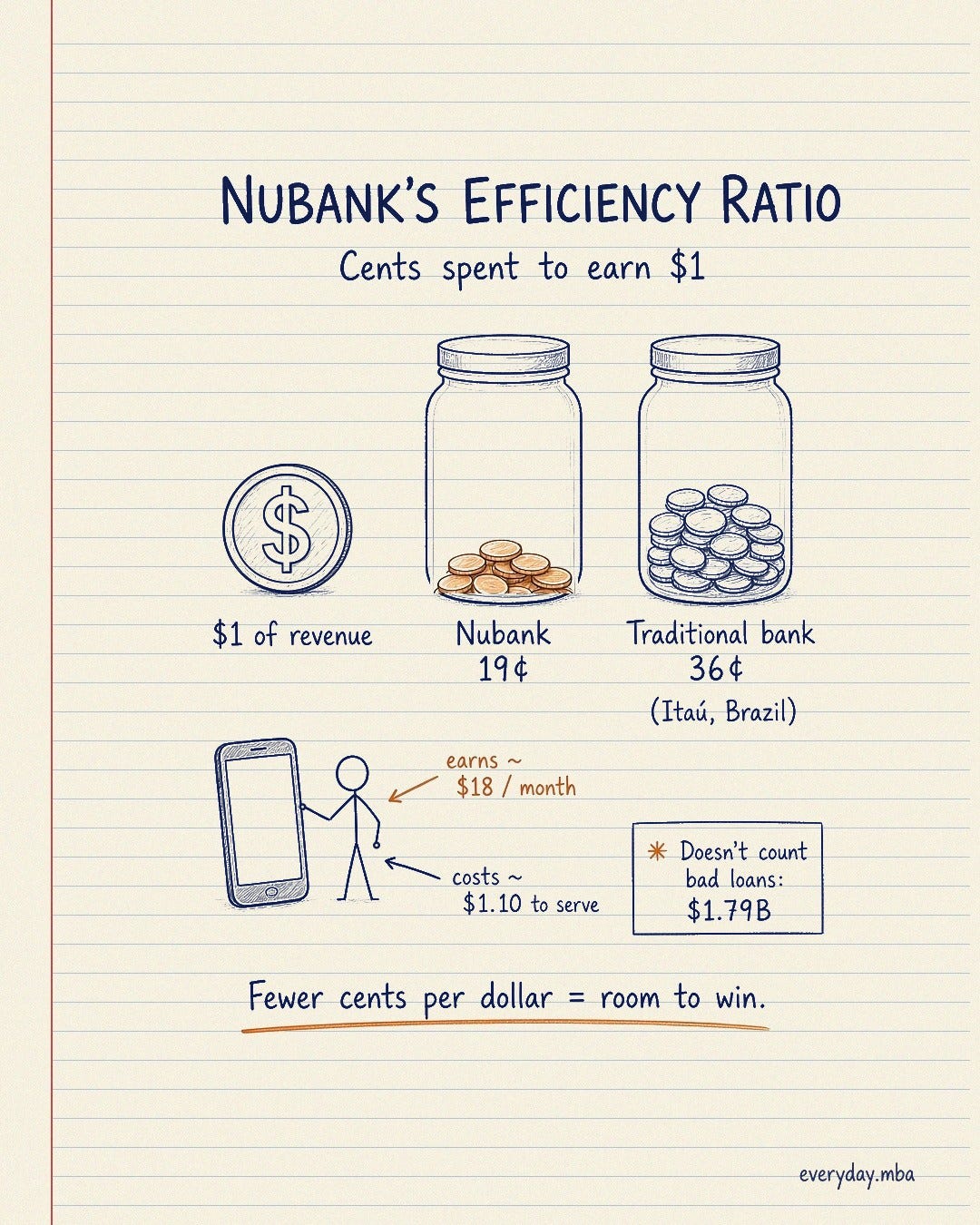
Now compare. Itaú Unibanco, a traditional Brazilian bank, reported an efficiency ratio of 35.7% for its Brazil business in the same quarter. That is close to 36 cents per dollar. Each bank defines the ratio a little differently, so treat the gap as rough. But the gap is large.
Where does the gap come from? Look at one customer. Nu says it earns about $18 a month from each active customer. It spends about $1.10 a month to serve that customer, counting transaction costs, support and operations. Revenue per customer grew 21% from a year earlier. Cost to serve grew about 10%. When revenue per customer grows faster than the cost to serve, the ratio falls.
That low cost is also a weapon. Nu’s CEO said the company uses its “cost structure advantage” to pass higher yields on to customers. A bank that spends less to run can pay savers more, charge borrowers less, or keep more profit. Nu gets to choose.
The ratio has limits, though. It does not count loan losses. Nu set aside $1.79 billion for bad loans this quarter, more than twice its operating expenses. A bank can look very efficient and still lose money if borrowers stop paying. The ratio also moves with timing. Nu said some spending slipped into the fourth quarter, so it expects the ratio to rise next quarter. It still expects 19% to 19.5% for the full year, better than its earlier view of about 20%.
How to Use It
1. Do the division. Take operating expenses and divide by revenue. For Nu, $846 million divided by $4.4 billion is about 19%. Say it as cents per dollar. It is easier to remember.
2. Compare like with like. Banks, airlines and retailers have very different cost structures. Compare a company with its own past and with close rivals, and check how each one defines the ratio.
3. Go down to one customer. Revenue per customer and cost to serve one customer tell you why the ratio moves. If the first grows faster than the second, efficiency improves.
4. Check what it leaves out. For banks, look at credit losses next to the efficiency ratio. For any business, ask which big costs sit outside the formula.
5. Watch the timing. One quarter can look better because spending was pushed out. Look at the full year and at guidance.
6. Use it at work. Track your own team’s cost per dollar of revenue, or cost per customer served. It shows whether growth is getting cheaper or more expensive.
Sources
1. Nu Holdings, “Nu Holdings Ltd. Reports Third Quarter 2026 Financial Results,” November 12, 2026. https://nu.com/en/newsroom/company/nu-holdings-ltd-reports-third-quarter-2026-financial-results
2. Nu Holdings, “Form 6-K: Q3’26 Earnings Presentation,” U.S. Securities and Exchange Commission, November 12, 2026. https://www.sec.gov/Archives/edgar/data/1691493/000129281426005275/nu20261112_6k.htm
3. The Motley Fool, “Nu Holdings (NU) Q3 2026 Earnings Call Transcript,” November 13, 2026. https://www.fool.com/earnings/call-transcripts/2026/11/13/nu-holdings-nu-q3-2026-earnings-call-transcript/
4. Itaú Unibanco, “Itaú Unibanco reports BRL 12.6 billion in net income and 23.6% ROE in the third quarter of 2026,” November 3, 2026. https://www.sec.gov/Archives/edgar/data/1132597/000113259726000271/pressrelease_3q26.htm