


The Story
On October 7, 2026, Levi Strauss & Co. reported results for its fiscal third quarter, which ended August 30. Net revenues rose 4% to $1.61 billion, or 5% excluding currency moves. Gross margin jumped 4.5 percentage points to 66.2%. Adjusted earnings per share, which exclude restructuring and other charges the company treats as unusual, came in at $0.48, up 41% from $0.34 a year earlier. Levi raised its full-year adjusted EPS forecast to $1.54 to $1.56, from $1.46 to $1.52.
Most of that jump came from one source. On February 20, 2026, the U.S. Supreme Court struck down the tariffs imposed under the International Emergency Economic Powers Act (IEEPA), and importers that had paid them became eligible for refunds. In the quarter, Levi recorded $78.6 million of refunds as a reduction in its cost of goods sold, plus $4.7 million of interest on them. It had collected $57.1 million in cash by quarter-end; the rest sits on the balance sheet as money still owed to it. CFO Harmit Singh told analysts the amount reflects “substantially all the refunds we expect to receive.”
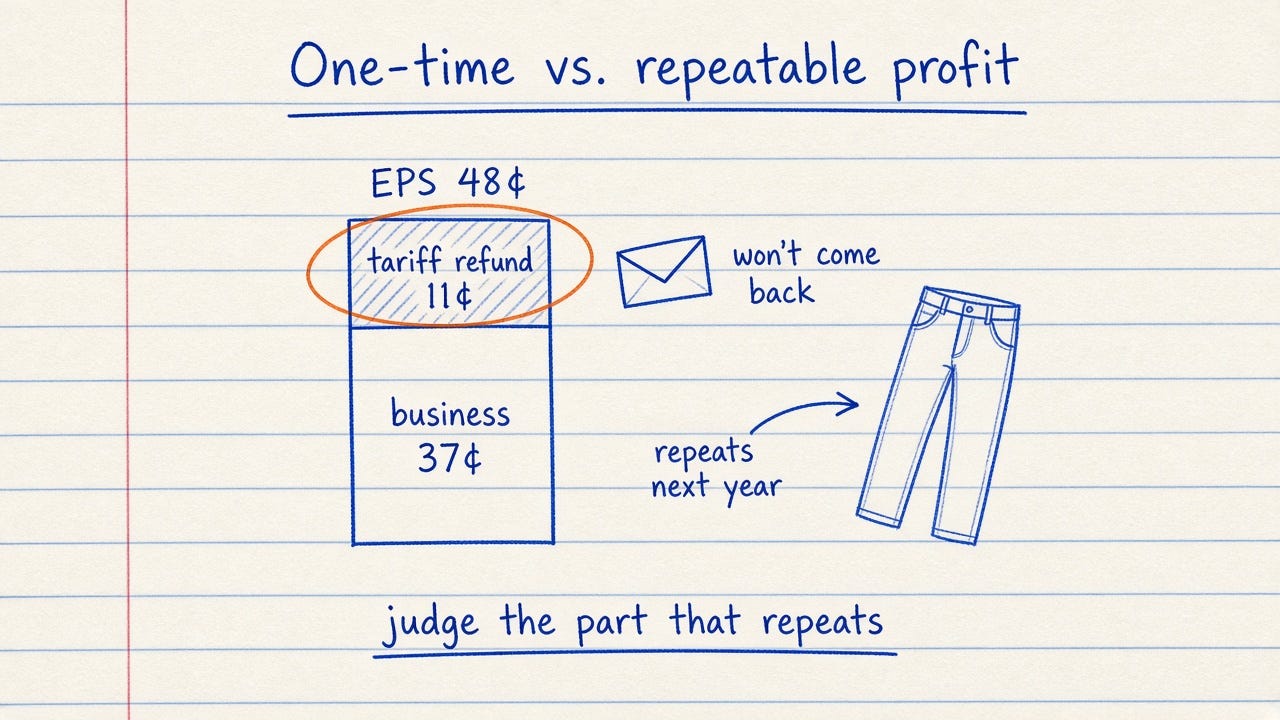
Levi was open about the math. Refunds added $0.16 to EPS, and the company spent about $0.05 of that right away on extra promotions and marketing, leaving a net benefit of $0.11. Without it, adjusted EPS was about $0.37, up roughly 9% from last year. That is the number CNBC compared with the $0.36 analysts expected, a narrow beat rather than a blowout. The same split runs through the margins: of the 4.5-point gross margin gain, 3.7 points came from the refund, net of what was spent. Underneath, revenue in the U.S. fell 1%, and comparable sales in Levi’s own stores and website were flat. Shares fell nearly 4% on Thursday, October 8, according to CNBC.
The Lesson
Earnings are worth more when they will repeat. Analysts call this earnings quality. A dollar of profit from selling more jeans at a better margin is likely to show up again next year. A dollar from a court-ordered tariff refund will not. Both land in the same income statement, so before you judge a company’s performance, you have to separate the profit that comes from running the business from the profit that came from a one-time event. The cleaned-up figure is what you use to compare years, judge management, and value the company.
Here is the part that catches people. “Adjusted” does not mean “one-time items removed.” Each company chooses what to adjust for. Levi’s adjusted EPS strips out restructuring charges, but it keeps the tariff refund in. Levi disclosed the refund’s effect in detail, which is why you can do the math at all. Many companies are less clear, and the burden falls on the reader to find the one-off and take it out.
One-time money also shapes how next year will look. Levi’s full-year forecast now includes a $0.04 net refund benefit, and it expects an adjusted operating margin of about 12.1%, of which about 0.3 points comes from the refund. Singh said the company plans to treat the all-in result as the base: “we end the year on a reported number, we lap that for next year.” That means 2027 has to beat a year that includes money that will not come back. Levi is betting the roughly $60 million of the $80 million refund it is putting into marketing, distribution, and holiday promotions will produce enough extra sales to cover that gap. If it does, the refund was a good investment. If it doesn’t, next year’s growth will look weaker than the business really is. The same check applies anywhere a one-off lands in the numbers: an insurance payout, a legal settlement, a gain on selling a building, or a tax credit.
How to Use It
1. Find the one-offs before you read the growth rate. Look for refunds, settlements, asset-sale gains, and insurance payouts in the earnings release footnotes and the 10-Q. If the company quantifies them, subtract them. If it doesn’t, ask.
2. Check what “adjusted” actually adjusts. Read the reconciliation table. A company can remove one-time costs while keeping one-time gains, which flatters the result.
3. Follow the cash. A refund booked as profit is not always cash in the bank. Levi had collected $57.1 million of $78.6 million by quarter-end. Compare reported gains with what was actually received.
4. Don’t let a windfall set your baseline. If one-time money lifts this year, show your board or your team the result with and without it, and set next year’s targets against the underlying number.
Sources
1. Levi Strauss & Co., “Levi Strauss & Co. Reports Third-Quarter Results,” press release (Exhibit 99.1 to Form 8-K, SEC EDGAR), October 7, 2026. https://www.sec.gov/Archives/edgar/data/94845/000009484526000048/exhibit991-3q2026pressrele.htm
2. Levi Strauss & Co., Quarterly Report on Form 10-Q for the period ended August 30, 2026 (SEC EDGAR), October 7, 2026. https://www.sec.gov/Archives/edgar/data/94845/000009484526000047/lvis-20260830.htm
3. Stock Analysis (data from Quartr), “Levi Strauss & Co. (LEVI) Q3 2026 Earnings Call Transcript,” October 7, 2026. https://stockanalysis.com/stocks/levi/transcripts/706678-q3-2026/
4. CNBC, “Levi Strauss hikes profit guidance after tariff refunds, but its sales outlook is less optimistic,” news article, October 7, 2026 (updated October 8, 2026). https://www.cnbc.com/2026/10/07/levi-strauss-levi-q3-2026-earnings.html
5. Levi Strauss & Co. Investor Relations, “Levi Strauss & Co. Reports Third-Quarter Results,” October 7, 2026. https://investors.levistrauss.com/news/financial-news/news-details/2026/Levi-Strauss--Co--Reports-Third-Quarter-Results/default.aspx