



A settlement left out of adjusted earnings is still money the company owes, so read the GAAP number and the adjusted number together before you decide how the quarter went.
The Story
On October 13, 2026, Johnson & Johnson reported results for its third quarter, which ended September 27. Sales rose 5.9% to $25.4 billion, from $24.0 billion a year earlier. Operational growth, which strips out currency moves, was 6.0%. The U.S. did most of the work: sales there rose 9.1% to $15.0 billion, while international sales grew 1.5% to $10.4 billion. Innovative Medicine, the drug business, grew 7.7% to $16.8 billion. MedTech grew 2.5% to $8.6 billion.
Then comes the bottom line. Net earnings fell to $210 million from $5.15 billion a year earlier, a drop of almost 96%. Diluted earnings per share were $0.09, compared with $2.12. On the company’s adjusted basis, net earnings were $6.34 billion and EPS was $2.59, down 7.5% from $2.80.
Most of the $2.50 gap between those two EPS figures comes from one line. In its reconciliation table, J&J lists a $5.519 billion pre-tax “litigation related” adjustment for the quarter. The company says the $0.09 reflects a one-time special charge for its proposed resolution of the ovarian talc litigation, along with its acquisition of Firefly Bio and a collaboration with Sail Biomedicines. Adjusted EPS removes the litigation charge but still carries the impact of those deals.
The charge ties back to July 27, 2026, when J&J proposed a $5.5 billion commitment to resolve the roughly 76,000 remaining ovarian talc claims. The deal depends on at least 95% of those claims taking part. The first payment, no more than $3 billion, would come in 2027, with nothing further due before 2028. J&J maintains the claims lack scientific merit. On the same day it reported the quarter, it raised its full-year guidance: reported sales at a $101.2 billion midpoint, growth of 7.4%, and adjusted EPS at an $11.10 midpoint, up $0.06 from before.
The Lesson
GAAP earnings and adjusted earnings answer different questions. GAAP, or generally accepted accounting principles, records everything that happened in the period, including costs management sees as unusual. Adjusted (non-GAAP) earnings take out the items the company decides aren’t part of its ongoing operations, so you can compare one quarter of the core business with the next. Both are useful, but neither one tells the whole story.
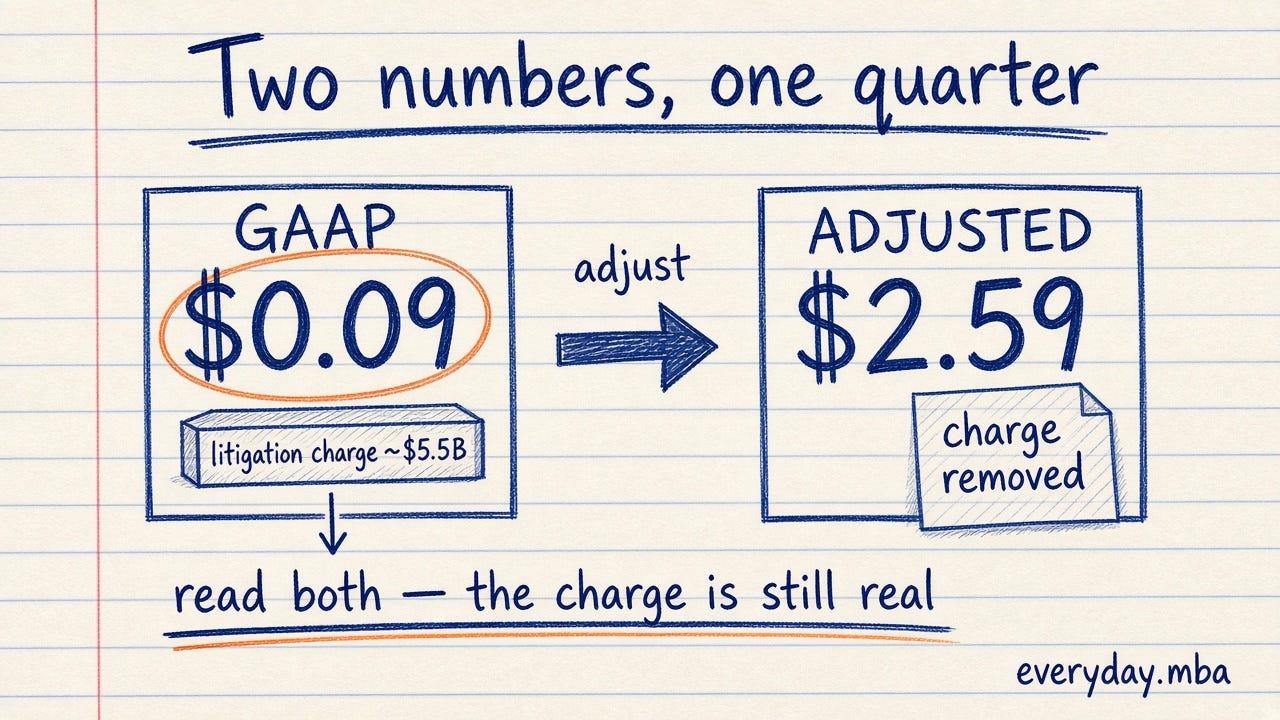
Last week’s Levi Strauss lesson covered the flattering version: a one-time tariff refund that lifted profit and stayed inside the adjusted number. J&J is the opposite case. A one-time cost wiped out GAAP earnings, and the adjusted figure takes it back out. For one purpose, that makes sense. If you want to know whether J&J’s drug and device businesses got stronger this quarter, a legal charge tied to products from years past won’t tell you much. Six percent sales growth and a raised outlook say the operations are healthy.
But “one-time” does not mean “not real.” If the resolution goes through, $5.5 billion leaves the company, starting with as much as $3 billion in 2027. That cash can’t go to research, acquisitions, dividends, or paying down debt. The guidance J&J raised is for adjusted EPS, which by design leaves the charge out. So a higher adjusted outlook and a multi-billion-dollar settlement can both be true at the same time. One number measures how the business is running. The other measures what shareholders actually earned after paying for the past.
How to Use It
1. Put the two numbers side by side. Find the GAAP-to-non-GAAP reconciliation, usually near the back of the earnings release, and list each adjustment with its size. At J&J, a single line, $5.519 billion of litigation, explains most of the gap.
2. Ask whether the excluded item costs cash. Some adjustments, like amortization of past acquisitions, are accounting entries with no new cash going out. A settlement is a real check. Note how much will be paid and when: here, up to $3 billion in 2027 and the rest in 2028 or later.
3. Check what the guidance measures. When a company raises its outlook, confirm which number it’s raising. J&J’s $11.10 adjusted EPS midpoint excludes the talc charge, so it describes the operations, not the full cost of being the company.
4. Count how often “one-time” shows up. Read the reconciliation for the last several quarters. If the same kind of charge keeps appearing, treat it as a cost of doing business. Use the same rule on your own books: if you leave a lawsuit, refund, or write-off out of your monthly numbers, keep a running total of it so it doesn’t drop out of sight.
Sources
1. Johnson & Johnson, “Johnson & Johnson Reports Q3 2026 Results; Raises 2026 Guidance,” press release, October 13, 2026. https://www.jnj.com/media-center/press-releases/johnson-johnson-reports-q3-2026-results-raises-2026-guidance
2. Johnson & Johnson, Form 8-K (Item 2.02), filed October 13, 2026 (SEC EDGAR). https://www.sec.gov/Archives/edgar/data/200406/000020040626000189/jnj-20261013.htm
3. Johnson & Johnson, Q3 2026 earnings press release with attachments, including GAAP-to-non-GAAP reconciliation (PDF). https://s203.q4cdn.com/636242992/files/content_files/3Q26-Earnings-Press-Release-Final-with-attachments.pdf
4. Johnson & Johnson, Q3 2026 Other Financial Disclosures (PDF). https://s203.q4cdn.com/636242992/files/content_files/3Q26-Other-Financial-Disclosures.pdf
5. Johnson & Johnson, “Johnson & Johnson Announces a Proposed Resolution of Ovarian Talc Litigation,” press release, July 27, 2026. https://www.investor.jnj.com/investor-news/news-details/2026/Johnson--Johnson-Announces-a-Proposed-Resolution-of-Ovarian-Talc-Litigation/default.aspx