



The Story
In September 2021, Intuit, the company behind TurboTax and QuickBooks, agreed to buy Mailchimp for about $12 billion in cash and stock. The email marketing service was supposed to help small businesses find and keep customers, right next to the QuickBooks software many of them already used to run their books.
On November 19, 2026, Intuit agreed to sell it. The buyer is Bending Spoons, an Italian company that owns established apps such as Evernote, Vimeo and WeTransfer. The price is about $3.68 billion. Intuit will put $368 million of that into new Bending Spoons shares and take the rest, about $3.31 billion, in cash. The deal still needs regulatory approval and is expected to close in early 2027. Intuit plans to use the cash to buy back its own stock.
The same day, Intuit reported its first quarter, which ended October 31. Total revenue grew 12%, to $4.35 billion. Its Online Ecosystem revenue, which includes QuickBooks Online, grew 20%. Mailchimp’s revenue fell 1%, to $313 million.
The Lesson
This is a divestiture: selling off a piece of a company. Intuit is getting back about 31 cents for every dollar it paid. That is a painful result. But the decision to sell is not really about 2021. It is about what Mailchimp is worth from here, and who should own it.
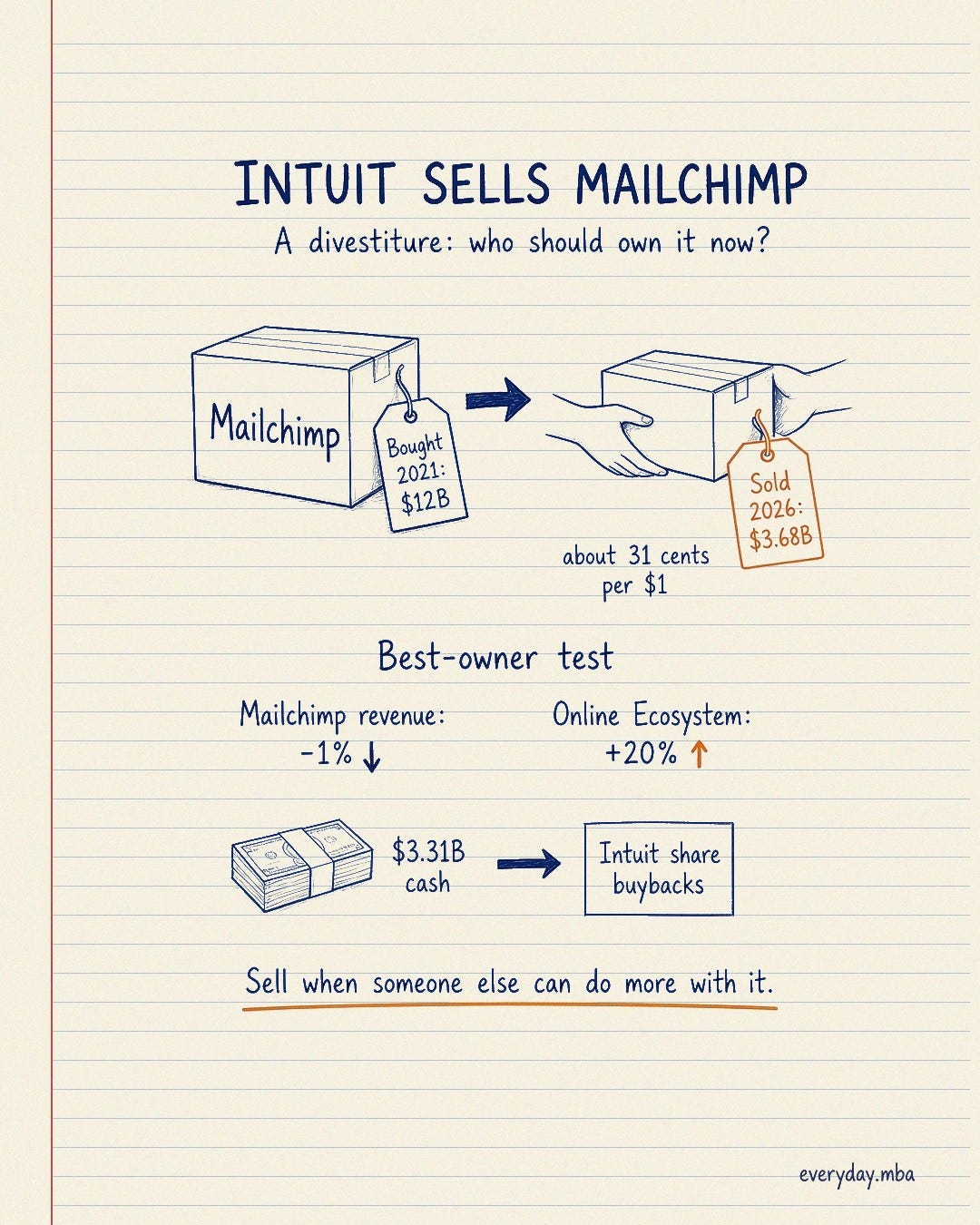
The first question is who the best owner is. A business is worth the cash it will produce in the future, and that depends on who runs it. If another company can grow it faster, run it more cheaply, or fit it better with what it already owns, that company can pay more than the business is worth to you. Bending Spoons is a consolidator that specializes in buying established apps. Intuit’s CEO, Sasan Goodarzi, said on the earnings call that Intuit still wants to help businesses with everything from finding a lead to getting paid, but believes it can do that better by building AI tools into QuickBooks than by owning Mailchimp.
The second question is whether the unit is holding the rest back. Mailchimp brought in about 7% of Intuit’s revenue last quarter, and it was shrinking while most of the company grew. Intuit expects Mailchimp’s revenue to be flat to down 1% this fiscal year, against 8% to 9% growth for the whole company. CNBC described Mailchimp as a drag on Intuit’s overall revenue growth. In August, Intuit had started reporting Mailchimp as its own segment, which made that gap easy for investors to see.
The third question is what the cash will do next. A sale turns a business back into money that can be used somewhere else. Intuit’s choice is share buybacks. Mailchimp is expected to bring in about $1.26 billion of revenue this fiscal year, so the price works out to roughly 2.9 times a year of sales. The sale makes sense if Intuit believes buying its own shares will earn more than keeping Mailchimp would.
The last question is what leaves with the business. A sale removes Mailchimp’s revenue and profit, not just its problems. Intuit’s current forecasts leave the deal out, and the company says it will update them when the sale closes. What it gets back is harder to measure: time and attention from managers who no longer have to fix a slow unit.
One caution. The deal has not closed yet, and the $368 million Intuit takes in Bending Spoons shares will be worth whatever those shares are worth later. Intuit is keeping a small bet on Mailchimp’s future, just under a new owner.
How to Use It
1. Separate the old price from the new decision. What a business cost years ago does not change what it is worth today. Judge the sale against its value from here.
2. Run the best-owner test. Ask who can get the most out of a business. If someone else can, they may pay more than it is worth to you.
3. Compare growth rates. Put a unit’s growth next to the rest of the company. A slow piece can hide inside a healthy total.
4. Follow the proceeds. A sale is only as good as what the cash does next. Ask whether that use beats keeping the business.
5. Use it at work. Apply the same test to products, projects and clients. If something takes attention but isn’t growing, ask whether someone else could do more with it.
Sources
1. Intuit Inc., “Intuit Reports First-Quarter Results and Enters Agreement to Sell Mailchimp to Bending Spoons,” November 19, 2026. https://investors.intuit.com/news-events/press-releases/detail/1331/intuit-reports-first-quarter-results-and-enters-agreement-to-sell-mailchimp-to-bending-spoons
2. Intuit Inc., Form 8-K current report (Mailchimp sale agreement), November 19, 2026. https://investors.intuit.com/sec-filings/all-sec-filings/content/0001193125-26-468834/d182669d8k.htm
3. Bending Spoons, “Bending Spoons has entered into a definitive agreement to acquire Mailchimp,” November 19, 2026. https://investors.bendingspoons.com/newsroom/bending-spoons-to-acquire-mailchimp
4. Intuit Inc., “Intuit to Acquire Mailchimp,” September 13, 2021. https://investors.intuit.com/news-events/press-releases/detail/162/intuit-to-acquire-mailchimp
5. CNBC, “Intuit to sell Mailchimp to Bending Spoons for $3.68 billion,” November 19, 2026. https://www.cnbc.com/2026/11/19/intuit-mailchimp-sale-bending-spoons.html
6. Fortune, “Intuit moves to sell Mailchimp for $3.68 billion as AI reshapes its growth strategy,” November 20, 2026. https://fortune.com/2026/11/20/intuit-sell-mailchimp-3-68-billion-ai-reshapes-growth-strategy-cfo/