



The Story
On November 5, 2026, IMAX reported results for its third quarter, which ended September 30. It was the best quarter in the company’s history. Revenue rose 64% from a year earlier to $174.6 million. Adjusted EBITDA more than doubled to $120.9 million, a 69% margin, up from about 49% a year ago.
The driver was the box office on IMAX screens. Moviegoers spent a record $712 million on IMAX tickets worldwide in the quarter, up 94% from a year earlier and nearly double the company’s previous quarterly record of $372 million. IMAX took 6.7% of the entire industry’s global box office for the quarter while running less than 1% of the world’s screens.
Then look at where that $712 million came from. Christopher Nolan’s The Odyssey brought in $538 million of it. The next biggest title, Spider-Man: Brand New Day, brought in $58 million. Everything else on the network combined accounted for roughly $116 million.
The Odyssey is now the highest-grossing IMAX release ever, with more than $550 million in IMAX box office to date. IMAX says it now expects to significantly beat its earlier 2026 target of $1.4 billion in global box office, and it points to strong pre-sales for December’s Dune: Part Three.
The Lesson
When one product produces most of the results, the headline number tells you how big the quarter was. The concentration number tells you how repeatable it is.
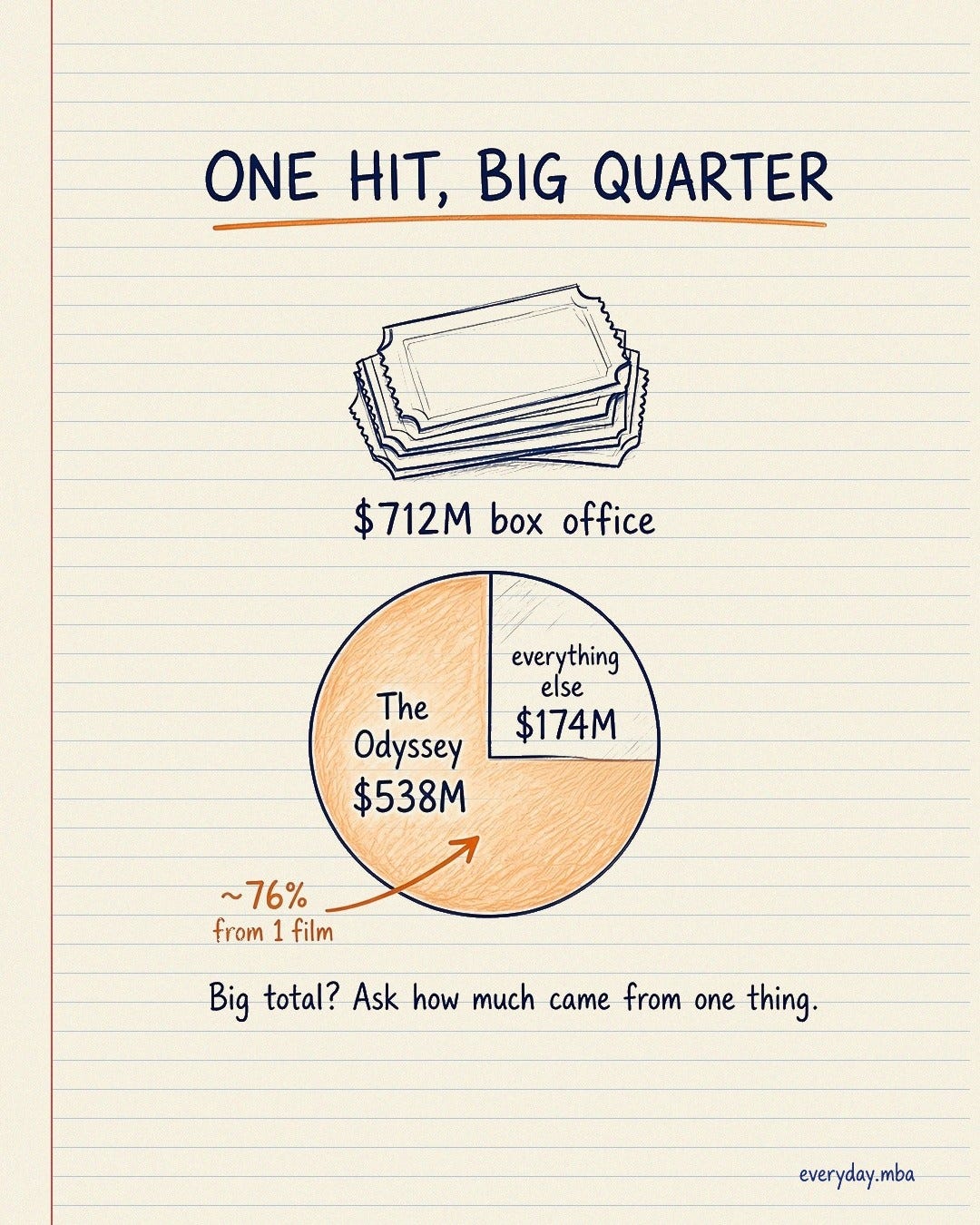
That is revenue concentration: how much of a company’s sales depend on a single product, customer, or event. At IMAX last quarter, one film produced about 76 cents of every box office dollar. That is extraordinary success. It is also a single point of dependence.
Concentration is not a flaw by itself. Hits are how entertainment works. A drug company can live on one blockbuster for a decade. A game studio can be carried by one title. A parts supplier can grow up alongside one giant customer. The problem is only when readers mistake a hit for a new baseline.
Here is the test. Take the hit out and ask what is left. Without The Odyssey, box office on IMAX screens would have come in at less than half of the old $372 million record. That doesn’t mean the rest of the business is weak. It means the record depends heavily on one release, and next quarter’s comparison will depend on whether another one shows up.
Second, ask whether the hit was luck or a system. IMAX’s case for “system” is that filmmakers keep choosing its format. The Odyssey was made entirely with IMAX technology, the 2027 slate includes several titles “Filmed for IMAX,” and IMAX has signed deals for more than 100 systems this year, 65% of them at new locations. A pipeline of future hits lowers concentration risk over time, even if any one quarter stays lumpy.
Third, notice that concentration cuts both ways when costs are mostly fixed. IMAX’s segment gross margin on content hit 76% because extra box office on the same screens costs little extra. That is why profit jumped faster than revenue. The same math works in reverse in a quarter without a big film.
So the right reaction to a record quarter like this is two questions at once: “How big was it?” and “How much of it came from one thing?”
How to Use It
1. Find the top item. Look for the biggest product, customer, or title in the report. Companies often name it.
2. Do the share math. Divide the top item by the total. A rough rule of thumb: once one item passes about a third, treat the result as concentrated. IMAX’s top film was about three-quarters.
3. Strip it out. Recompute the period without the top item and compare that number to normal periods. That is your rough baseline.
4. Check the pipeline. Is there a next hit, a next big customer, a next launch? Look for signed contracts and dated releases, not hopes.
5. Mind the fixed costs. If most costs don’t move with sales, a hit inflates margins and a miss deflates them. Expect swings.
6. Use it at work. If one client, product, or campaign is driving your numbers, report it separately. Show the total and the total without it, so no one plans next year on a one-time peak.
Sources
1. IMAX Corporation, “IMAX Corporation Reports Record Third Quarter 2026 Results,” November 5, 2026. https://investors.imax.com/news-releases/news-release-details/imax-corporation-reports-record-third-quarter-2026-results
2. IMAX Corporation, Earnings Release (Exhibit 99.1 to Form 8-K), quarter ended September 30, 2026, filed November 5, 2026. https://www.sec.gov/Archives/edgar/data/921582/000162828026070630/imax-q32026epr.htm
3. Deadline, “’The Odyssey’ Powers Record Q3 For Imax, Stock Jumps, CEO On Platform’s ‘Power And Potential,’” November 5, 2026. https://deadline.com/2026/11/the-odyssey-imax-quartelry-earnings-1237214226/