

The Story
On November 17, 2026, Home Depot reported its third quarter. On the surface, it was a solid one. Sales were $43.4 billion, up $2.0 billion, or 4.9%, from a year earlier. Comparable sales, which leave out the boost from new stores, rose 2.2%. Net earnings were $3.7 billion, up 3.1%. The company also named its finance chief, Richard McPhail, as its next CEO.
Later on the earnings call, McPhail read out a number that got less attention. Home Depot’s return on invested capital was 24.5%, down from 26.3% a year earlier. Profit went up. The return on the money tied up in the business went down.
The Lesson
Return on invested capital, or ROIC, asks one question: for every dollar put into a business, how much profit comes back each year? The formula is after-tax operating profit divided by invested capital. Invested capital is the money lenders and owners have put in, so debt plus equity.
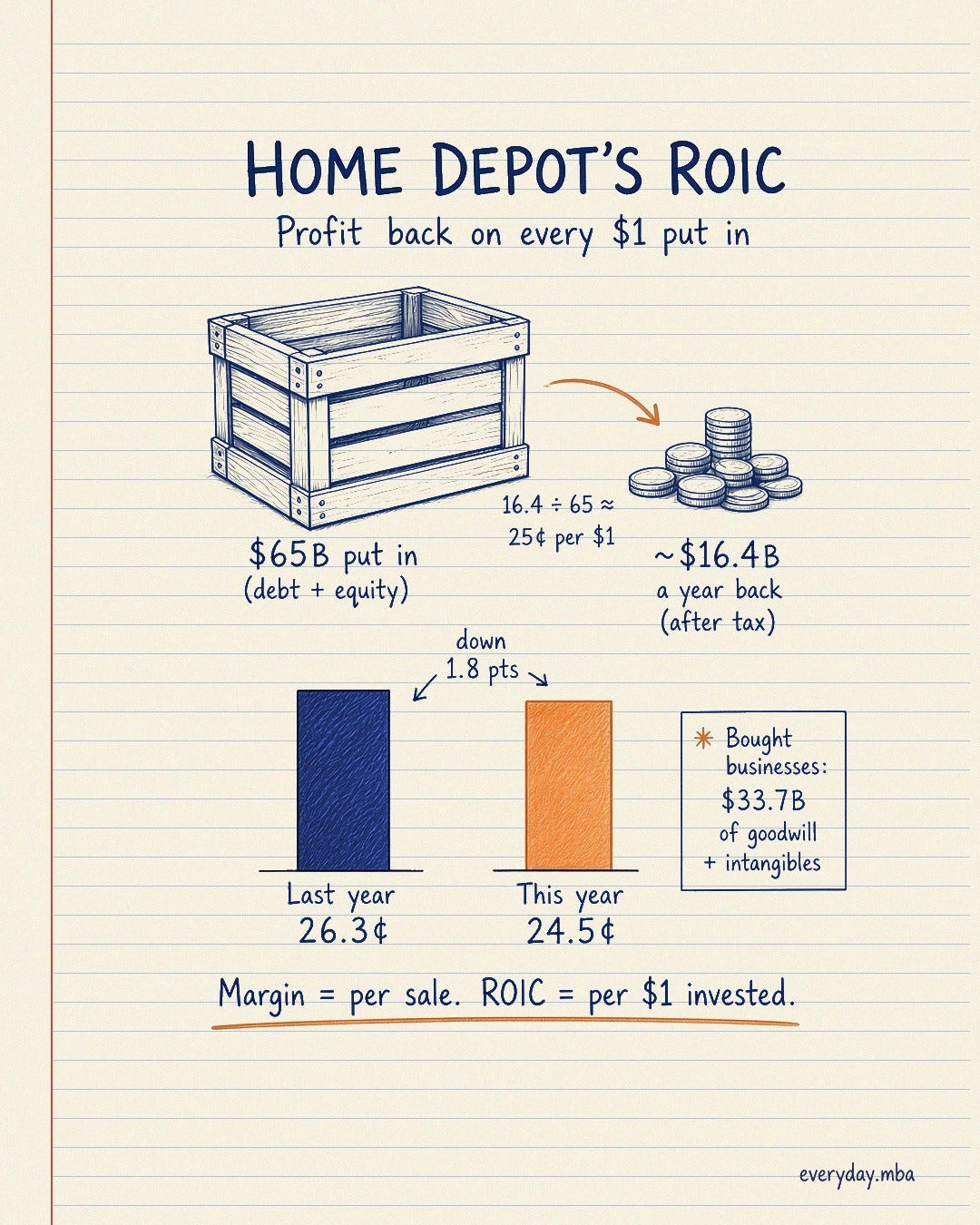
You can rough it out yourself from the earnings release. Home Depot made $5.5 billion of operating profit in the quarter. Its tax rate was about 25%, which leaves about $4.1 billion after tax. Times four, that is about $16.4 billion a year. Long-term debt plus shareholders’ equity was about $65 billion. Divide $16.4 billion by $65 billion and you get about 25%. That is close to the company’s 24.5%, which uses a full 12 months of profit and an average of the capital.
So why did it fall? Because the bottom of the fraction grew faster than the top. Operating profit for the first nine months of the year grew just 1.5%. Meanwhile, average debt and equity over the past year were higher than the year before. Part of the reason is that Home Depot has been buying businesses, including SRS, a roofing and building-products distributor, and GMS, which sells wallboard and ceilings. When you buy a company, you pay up front for profits that arrive over many years. Goodwill and intangible assets, which come mostly from past purchases rather than stores or stock, now add up to $33.7 billion. That is almost a third of Home Depot’s $110.1 billion in total assets. Inventory also grew $1.4 billion, to $27.6 billion, and turned over a little more slowly, 4.4 times a year instead of 4.5.
ROIC is different from margin, and McPhail made that point himself. Years ago, he said, Home Depot pushed into appliances, a category with “lower than company average margin, but much higher than company average return on invested capital.” Margin tells you what you keep from each sale. ROIC tells you what you earn on each dollar you had to commit to make those sales. A thin-margin product that sells fast and needs little capital can be a great business.
Last, compare ROIC with what the money costs. Home Depot’s interest expense was $579 million in the quarter on about $52.5 billion of debt, roughly 4.4% a year. Shareholders expect more than lenders, but a 24.5% return is still well above what Home Depot pays for its money. The slide is worth watching because it means newer dollars are earning less than older ones.
How to Use It
1. Rough out the math. Take operating profit, subtract taxes, and divide by debt plus equity. You do not need the exact company formula to see the level and the direction.
2. Ask which part moved. A falling ROIC can mean profit slowed, capital grew, or both. For Home Depot, capital grew faster than profit.
3. Watch acquisitions. Deals add capital on day one and profit over years. Judge a deal by the return on what was paid, not by how much revenue it adds.
4. Separate margin from return. A lower-margin product can earn a higher return if it needs less inventory or space. Ask both questions before you cut a product line.
5. Compare with the cost of money. A business creates value when its return is above what its money costs. The bigger that gap, the more each new dollar is worth.
6. Use it at work. Before asking for budget, estimate the yearly profit the money should bring back, then divide by the amount. That one ratio makes your case clearer.
Sources
1. The Home Depot, “The Home Depot Announces Third Quarter Fiscal 2026 Results; Updates Fiscal 2026 Guidance,” November 17, 2026. https://corporate.homedepot.com/news/earnings/home-depot-announces-third-quarter-2026-earnings
2. The Home Depot, “Form 8-K, Exhibit 99.1: Third Quarter Fiscal 2026 Results” (financial tables), U.S. Securities and Exchange Commission, November 17, 2026. https://www.sec.gov/Archives/edgar/data/354950/000035495026000184/hd_exhibit991x11012026.htm
3. The Motley Fool, “Home Depot (HD) Q3 2026 Earnings Call Transcript,” November 17, 2026. https://www.fool.com/earnings/call-transcripts/2026/11/17/home-depot-hd-q3-2026-earnings-call-transcript/
4. CNBC, “Home Depot names Richard McPhail as new CEO, beats earnings expectations,” November 17, 2026. https://www.cnbc.com/2026/11/17/home-depot-hd-q3-earnings-2026.html