


The Story
Frontline owns oil tankers and rents them out to companies that need to move crude and fuel across the ocean. It rents them two ways. Some ships work on the spot market, where each trip is priced at whatever the market pays that week. Others go out on time charters, where a customer rents the ship for months or years at a fixed daily rate.
On November 20, 2026, Frontline reported its third quarter. Its biggest ships, very large crude carriers that each carry about two million barrels of oil, earned an average of $148,500 a day on the spot market and $88,600 a day on time charters. Profit was $641.4 million, which included a $111.2 million gain from selling two older tankers.
The bigger news was the fourth quarter. Frontline says escalation in the Middle East, including attacks on tankers around the Strait of Hormuz, has made voyages longer and slower. Its CEO, Lars H. Barstad, said freight rates have moved to all-time highs. Frontline has already booked 68% of its open-market days for its biggest ships at $562,600 a day. The same class of ships on fixed contracts is set to earn about $90,800 a day.
The Lesson
This is the choice between spot pricing and contract pricing. Spot pricing means you take whatever the market pays right now. Contract pricing means you agree on a price in advance and live with it, up or down. Most businesses make this choice somewhere, whether they sell shipping, electricity, raw materials or consulting hours.
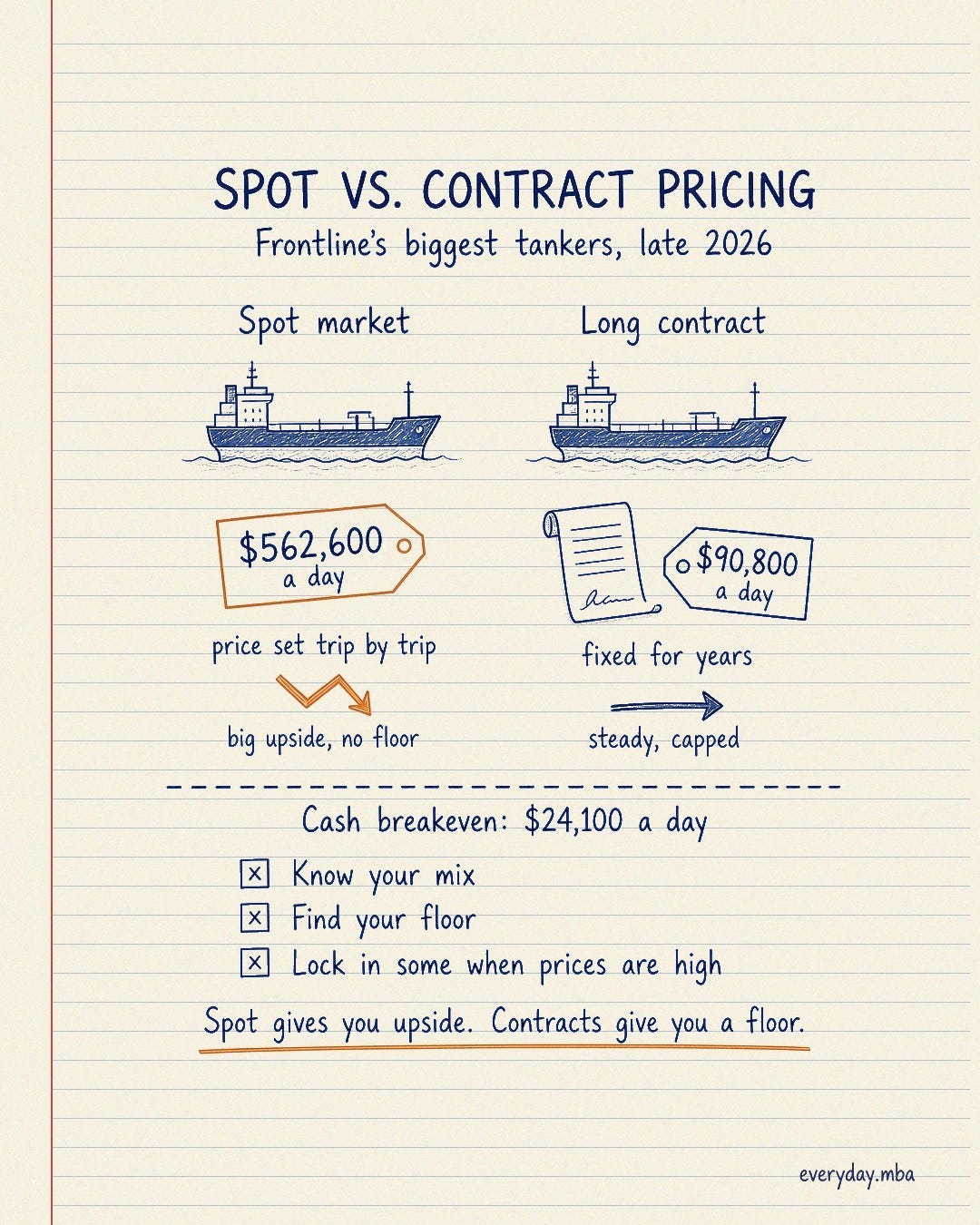
Spot pricing gives you the upside. When the market jumps, your revenue jumps with it the same week. Frontline’s open-market rate for its biggest ships is now about six times the contract rate. Every booked day on spot instead of a contract captures that gap.
Contract pricing gives you a floor. Frontline says its biggest ships need about $24,100 a day to cover their cash costs over the next year, including running costs and debt payments. A contract near $90,000 a day clears that easily, whatever happens to the market. As of November 20, 17 of Frontline’s ships, 15 of them the largest kind, were on contracts longer than a year.
That floor has a price, and you can see it this quarter. In July, Frontline rented one of its biggest ships out for two years at an average of $90,000 a day. That deal pays the same whether the market soars or slumps. Today, open-market trips pay several times more. Barstad told analysts that when you can earn so much on spot right now, “it kind of hurts” to lock in contracts. He still said investors should expect Frontline to put more of its fleet on contracts than in past years.
That sounds backwards until you remember why spot rates are this high. They are high because the market is disrupted, and disruptions end. Barstad noted that long contracts are priced well below today’s spot rate, which tells you the market expects rates to come down. Locking in some ships now turns part of a lucky stretch into cash Frontline can count on later.
Booked rates are also not the same as earned rates. In August, Frontline had booked 86% of its third-quarter spot days for its biggest ships at $156,900 a day. The full quarter came in at $148,500, because Frontline counts no revenue on the days a ship sails empty to its next cargo. Frontline has warned that the fourth quarter will also finish below the rate booked so far.
The real skill is the mix. All spot means feast or famine. All contracts means you miss every boom. Most good operators keep some of each and shift the balance as the market changes.
How to Use It
1. Know your mix. List how much of your revenue is priced fresh each time and how much is locked in. That split decides how much a market swing will hit you.
2. Find your floor. Work out the price you need just to cover your costs. The further your contracts sit above it, the more safely you can leave the rest open.
3. Price the trade-off. A contract gives up some upside in exchange for certainty. Ask what that certainty is worth to you, given your debts and your cash.
4. Lock in when things are good. The best time to sign long deals is when prices are high and people expect them to fall, not after they already have.
5. Use it at work. Freelance day rates versus retainers, hourly billing versus fixed-fee projects, and buying supplies as needed versus annual contracts are all the same choice. Decide on purpose instead of by habit.
Sources
1. Frontline plc, “FRO: Third Quarter and Nine Months 2026 Results,” November 20, 2026. https://www.frontlineplc.cy/fro-third-quarter-and-nine-months-2026-results/
2. Frontline plc, Form 6-K, Exhibit 1, “Frontline plc Reports Results for the Third Quarter Ended September 30, 2026,” U.S. Securities and Exchange Commission, November 20, 2026. https://www.sec.gov/Archives/edgar/data/913290/000091957426008221/p15160196_exh-1.htm
3. The Motley Fool, “Frontline (FRO) Q3 2026 Earnings Call Transcript,” November 20, 2026. https://www.fool.com/earnings/call-transcripts/2026/11/20/frontline-fro-q3-2026-earnings-call-transcript/
4. Baird Maritime, “Frontline posts $641.4m profit as Q4 tanker spot bookings reach records,” November 23, 2026. https://www.bairdmaritime.com/shipping/tankers/frontline-books-record-tanker-rates