



The Story
On November 4, 2026, FIS, a financial technology company that runs core banking, card processing, and payments software for banks, reported its third quarter. The quarter itself was fine. Adjusted earnings per share were $1.61, up 6.6% from a year earlier and a penny above what analysts expected. Revenue of about $3.45 billion also came in slightly ahead.
The stock still fell 23.7% that day, from $38.99 to $29.76. Bloomberg reported the intraday drop was the stock’s biggest decline since November 2022.
The reason was the outlook, not the quarter. FIS cut its 2026 forecast for adjusted earnings per share to $5.82 to $5.89, down from $6.15 to $6.24 in August. At the midpoints, that is a cut of about 5.5%. It also gave a first look at 2027 and said it expects adjusted earnings per share to decline in the high single digits to low double digits next year. Management blamed delayed bank client conversions, fewer one-time license sales and termination fees, and more spending on cybersecurity.
The same morning, FIS said its chief financial officer would step down the next day. The company also kept share buybacks on hold while it pays down debt.
The Lesson
A stock price is two numbers multiplied together: what the company earns per share, and how many dollars investors are willing to pay for each dollar of those earnings. That second number is the price-to-earnings multiple, or P/E.
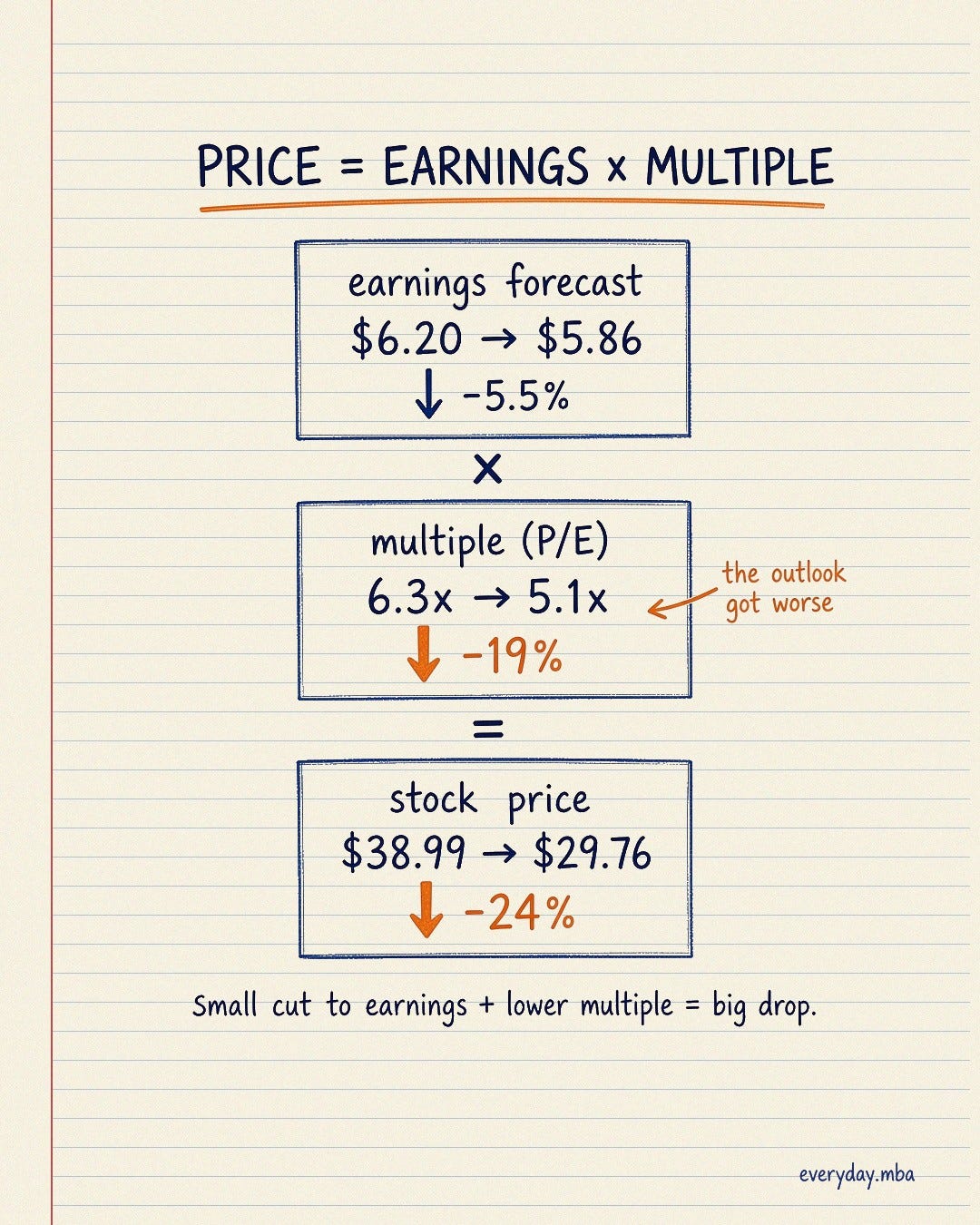
Price = earnings per share × P/E multiple.
Run FIS through it. Before the report, the stock was $38.99 and the 2026 earnings forecast midpoint was about $6.20. That is a multiple of about 6.3 times. After the report, the stock was $29.76 and the forecast midpoint was about $5.86. That is about 5.1 times.
So two things fell at once. The earnings estimate dropped about 5.5%. The multiple dropped about 19%. Keep about 94.5% of the earnings and about 81% of the multiple, and you keep about 76% of the price. That is the roughly 24% drop.
Why would the multiple fall at all? Because the multiple is where investors put their view of the future. A company expected to grow earnings year after year earns a higher multiple. A company expected to shrink earnings earns a lower one. FIS didn't just lower this year's number. It told investors next year's earnings would go down too. That changes what a dollar of today's earnings is worth.
There is also a trust piece. This was the second time in a row FIS lowered its 2026 profit outlook (it was $6.22 to $6.32 in May), and the CFO stepped down the next day. When forecasts keep moving down, investors start to discount the next forecast too. That shows up as a lower multiple, not a lower earnings line.
This is why “beat on the quarter, cut the outlook” so often ends badly. The quarter is already in the past. The price is mostly about what comes next, and how much investors believe it.
How to Use It
1. Split the move. When a stock jumps or drops on news, divide the price by the earnings estimate before and after. See how much came from earnings and how much from the multiple.
2. Read the outlook first. On earnings day, skip to the guidance table. A small beat on the quarter rarely outweighs a cut to the year.
3. Watch the direction of revisions. One cut can be a stumble. Two in a row usually costs credibility, and that hits the multiple.
4. Look one year further out. Investors price next year as much as this one. A first look at the following year can move the stock more than the quarter just reported.
5. Don't call a low multiple automatically cheap. A low P/E can be an opportunity, or it can be the market's verdict that earnings will shrink. Ask which one it is.
6. Use it at work. When you present a forecast, a small miss on the number hurts less than a habit of missing. Set targets you can hit, and explain changes early.
Sources