



When sales grow faster than the cost of running the business, profit grows faster still—that’s operating leverage, and it works in both directions.
The Story
On October 14, 2026, Fastenal, the industrial supplier that sells fasteners, safety supplies, and cutting tools to manufacturers, builders, and other businesses, reported results for its third quarter ended September 30. Net sales rose 15.5% to $2.46 billion, up $330.0 million from $2.13 billion a year earlier, with the same number of business days in both periods. The company credited share gains with larger customers, pricing actions, and broad demand. Sales to contract customers, which include national multi-site accounts, grew 18.8% on a daily basis, while non-contract sales grew 7.8%.
Profit grew faster than sales. Operating income rose 20.2% to $530.8 million from $441.5 million. Net income rose 19.7% to $401.6 million, or $0.35 per diluted share, up from $0.29.
The interesting part is how. Gross margin, the share of each sales dollar left after paying for the products, actually slipped to 44.8% from 45.3%. Fastenal said a shift toward larger customers cut gross margin by about 50 basis points because those accounts usually carry lower margins. But selling, general, and administrative (SG&A) expenses grew only 9.4%, to $573.9 million, so they fell to 23.3% of sales from 24.6%. Occupancy costs improved as a share of sales “driven mainly by fixed cost leverage,” and base pay leveraged through higher labor productivity. Full-time-equivalent headcount rose just 0.8% over twelve months. The result: operating margin climbed to 21.5% from 20.7%.
Investors still sold. Shares fell more than 5% to $48.61 after the report, Reuters said, as one analyst pointed to September daily sales growth of 14.4%, below the roughly 17% to 18% investors had hoped for.
The Lesson
Operating leverage is what happens when a big chunk of your costs doesn’t move with sales. Rent, warehouses, trucks, and base salaries cost roughly the same whether a branch ships a little more or a little less. When sales rise, those costs get spread over more revenue, so each extra dollar of sales carries more profit than the average dollar did. Fastenal shows the math. It added $330.0 million of sales and $89.3 million of operating income, so about 27 cents of each extra sales dollar became operating profit, versus an average of 20.7 cents (a 20.7% operating margin) a year earlier. That’s why a 15.5% sales gain became a 20.2% profit gain.
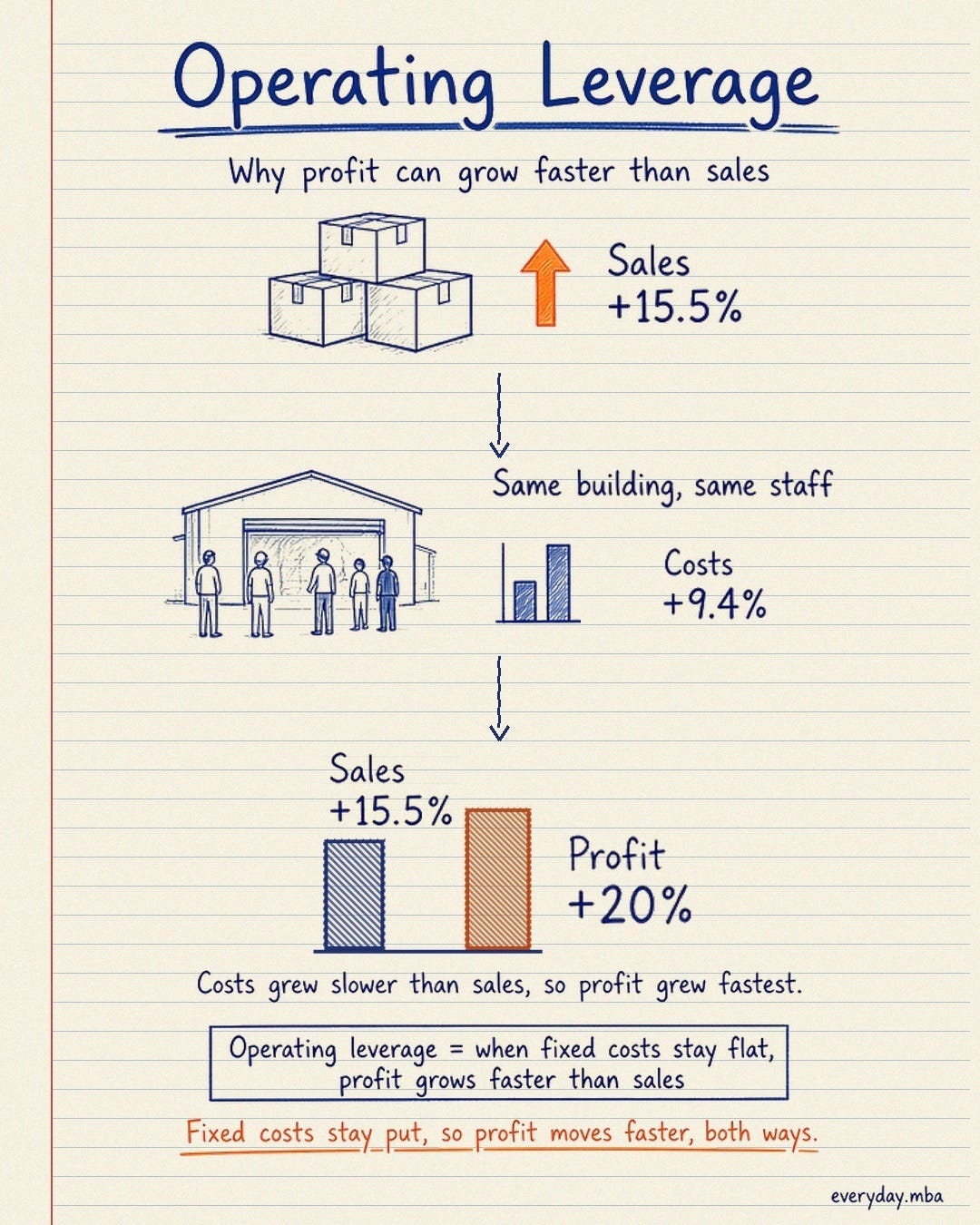
It also explains a trade-off that looks wrong at first. Big customers usually carry lower gross margins, so the mix shift pulls gross margin down. But they bring higher volumes that run through the same buildings and staff, so the extra gross profit dollars outrun the extra operating costs. Fastenal said these relationships “generate higher absolute profit dollars and are accretive to operating margin.” A lower gross margin and a higher operating margin can both be true when the fixed-cost base is doing the work.
The catch is that leverage cuts both ways. Those same fixed costs don’t shrink when sales slow. If growth fades, profit can fall faster than sales for the same reason it rose faster. That’s why investors watched the September sales number so closely. In a business built on operating leverage, the growth rate is the profit story.
How to Use It
1. Compare profit growth to sales growth. If operating income grows faster than revenue, ask why. Fastenal’s 20.2% against 15.5% points to costs growing slower than sales, here SG&A up 9.4%.
2. Calculate the incremental margin. Divide the change in operating income by the change in sales. When that number beats the company’s average margin, the fixed-cost base is being leveraged.
3. Don’t panic at a lower gross margin. Check the line below it. A mix shift toward bigger, higher-volume customers can lower gross margin and still raise operating margin, as it did here.
4. Stress-test the downside. Before you cheer leverage, ask which costs stay put if sales slow. The more fixed the cost base, the harder profit falls in a downturn.
5. Use it in your own work. If you run a team, a shop, or a side business, add volume before you add fixed costs like space or salaried hires, and watch growth
Sources
1. Fastenal Company, “Fastenal Company Reports 2026 Third Quarter Earnings,” press release, October 14, 2026. https://investor.fastenal.com/news/news-details/2026/Fastenal-Company-Reports-2026-Third-Quarter-Earnings/default.aspx
2. Fastenal Company, Form 8-K (Item 2.02), filed October 14, 2026 (SEC EDGAR). https://www.sec.gov/Archives/edgar/data/815556/000081555626000046/0000815556-26-000046-index.htm
3. Fastenal Company, Exhibit 99.1 to Form 8-K (third quarter 2026 earnings release), filed October 14, 2026 (SEC EDGAR). https://www.sec.gov/Archives/edgar/data/815556/000081555626000046/ex_99109302026earningsrele.htm
4. Reuters (via Boursorama, French-language automated translation), “Fastenal en baisse après la publication de ses résultats du troisième trimestre,” October 14, 2026. https://www.boursorama.com/bourse/actualites/fastenal-en-baisse-apres-la-publication-de-ses-resultats-du-troisieme-trimestre-09d28a0ef5468abbd687f2282a27f356closely once you do.