


The Story
On October 28, 2026, eBay reported results for its third quarter ended September 30. Buyers and sellers completed $23.2 billion of transactions on its marketplaces, up 15% from a year earlier. eBay calls this gross merchandise volume, or GMV. It counts the full value of every paid transaction, including shipping and taxes, before returns or cancellations.
eBay’s own revenue was much smaller: $3.2 billion, up 14%. Of that, $607 million came from advertising, including $575 million from ad products on eBay’s own marketplace.
Growth was uneven. U.S. GMV rose 27%, while international GMV rose 4%. Some of the growth came from buying other marketplaces. eBay closed its purchase of Depop, a person-to-person fashion marketplace, from Etsy on July 30 for $1.4 billion in cash. It also completed its purchase of Tise on October 1, 2025. Active buyers reached 147 million, up 10%. Without Depop and Tise, the count was 136 million, up 1%.
In France and Italy, eBay rolled out an improved setup for individual sellers that includes free selling.
The Lesson
A marketplace has two size numbers. GMV tells you how much business flows through the platform. Revenue tells you how much of that flow the company keeps. The ratio between them is the take rate.
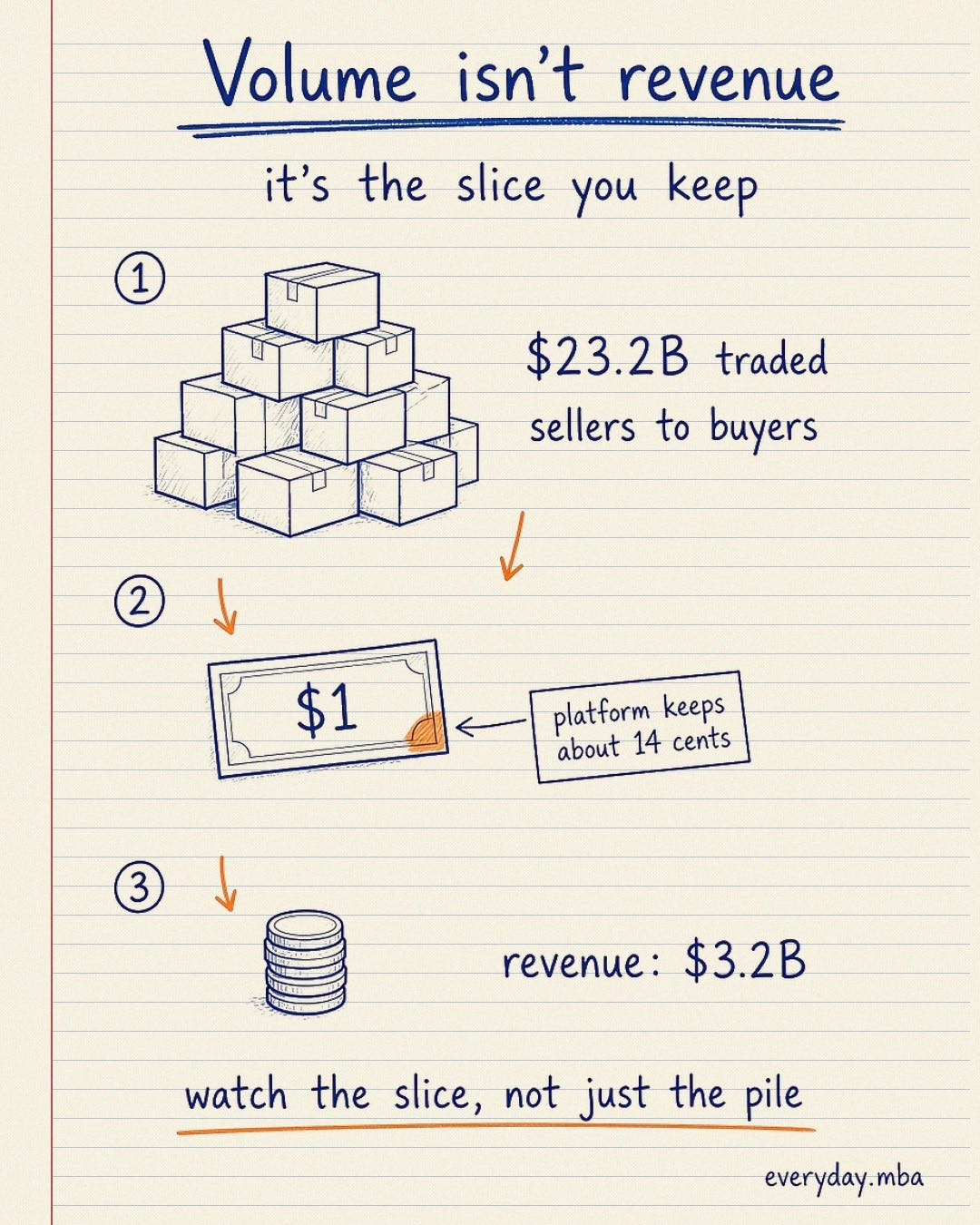
eBay doesn’t print a take rate in this release, but you can work it out. Divide $3,206 million of revenue by $23,166 million of GMV, and you get 13.8%. A year ago, it was $2,820 million on $20,105 million, or 14.0%. So eBay kept about $13.84 of every $100 traded, down from about $14.03.
That sounds tiny, but it adds up. If eBay had kept last year’s take rate, this quarter’s revenue would have been about $43 million higher. It’s also why revenue grew 14% while GMV grew 15%. When the take rate slips, the company grows a little slower than its marketplace.
The take rate is really a price. It’s the bundle of fees, ads and services sellers pay to reach buyers. Raise it too far and sellers list less or move to a rival. Cut it, for example with free selling, and you may win more sellers and buyers, but each dollar of GMV earns less. Platforms often make that trade on purpose to grow, so the question is whether the volume shows up.
Ads are part of that price. eBay’s $607 million of ad revenue equals about 2.6% of GMV. Marketplace ads are usually bought by sellers who want their listings seen, on top of basic fees, so they’re a useful sign of how much sellers value the traffic.
Look forward, too. For the fourth quarter, eBay guided to $3.19 to $3.24 billion of revenue on $23.7 to $24.1 billion of GMV. At the midpoints, that’s a take rate of about 13.5%, lower than this quarter.
Finally, keep the two growth stories apart. Part of this quarter’s growth came from buying Depop and Tise. The buyer count shows it: up 10% with them, 1% without. Buying a marketplace adds its volume overnight. Earning more volume from the buyers you already have is harder, and it tells you more.
How to Use It
1. Always ask for both numbers. When a marketplace brags about GMV, find its revenue. Volume is not money in the bank.
2. Do the division yourself. Revenue divided by GMV gives the take rate. Track it every quarter. A small move on a big base is real money.
3. Read the take rate as a price. If it falls, ask whether that was a choice to win volume or pressure from rivals. Then check if the volume actually grew.
4. Split bought from built. Separate acquired volume from growth in the existing business before you judge the trend.
5. Apply it to your own work. If you sell through a platform, know its take rate. If you run one, know how much sellers will pay before they leave.
Sources
1. eBay Inc., “eBay Inc. Reports Third Quarter 2026 Results,” news release, October 28, 2026. https://investors.ebayinc.com/investor-news/press-release-details/2026/eBay-Inc--Reports-Third-Quarter-2026-Results/default.aspx
2. eBay Inc., Form 8-K, filed October 28, 2026 (SEC EDGAR). https://www.sec.gov/Archives/edgar/data/1065088/000106508826000209/0001065088-26-000209-index.htm
3. eBay Inc., Exhibit 99.1 to Form 8-K (third-quarter 2026 earnings release, including GMV, active buyers and business outlook), filed October 28, 2026 (SEC EDGAR). https://www.sec.gov/Archives/edgar/data/1065088/000106508826000209/exhibit991erebayq32026.htm