



The Story
Dollar Tree is a discount retailer with 9,511 stores across the U.S. and Canada. On November 24, 2026, Dollar Tree reported its third quarter, which ended October 31. Sales grew 6.9% to $5.1 billion, and the number of shopper visits to stores open at least a year rose 3.8%.
Profit went the other way. Operating income, what is left after running the stores, fell 10.1% to $309 million. Net income, the bottom line, slipped about 5%, to $232.0 million from $244.6 million a year earlier. Part of that dip was a choice. Dollar Tree spent about $103 million of money it had gotten back from tariff refunds on the business, including a $40 million charitable donation.
And yet the headline number most investors watch went up. Earnings per share rose 3.3%, to $1.24 from $1.20, and the stock jumped more than 12% before the market opened.
The Lesson
Earnings per share, or EPS, is profit divided by the number of shares. It tells you how much profit belongs to each single share of the company. That means there are two ways to make it grow. You can earn more profit, or you can have fewer shares to split it among.
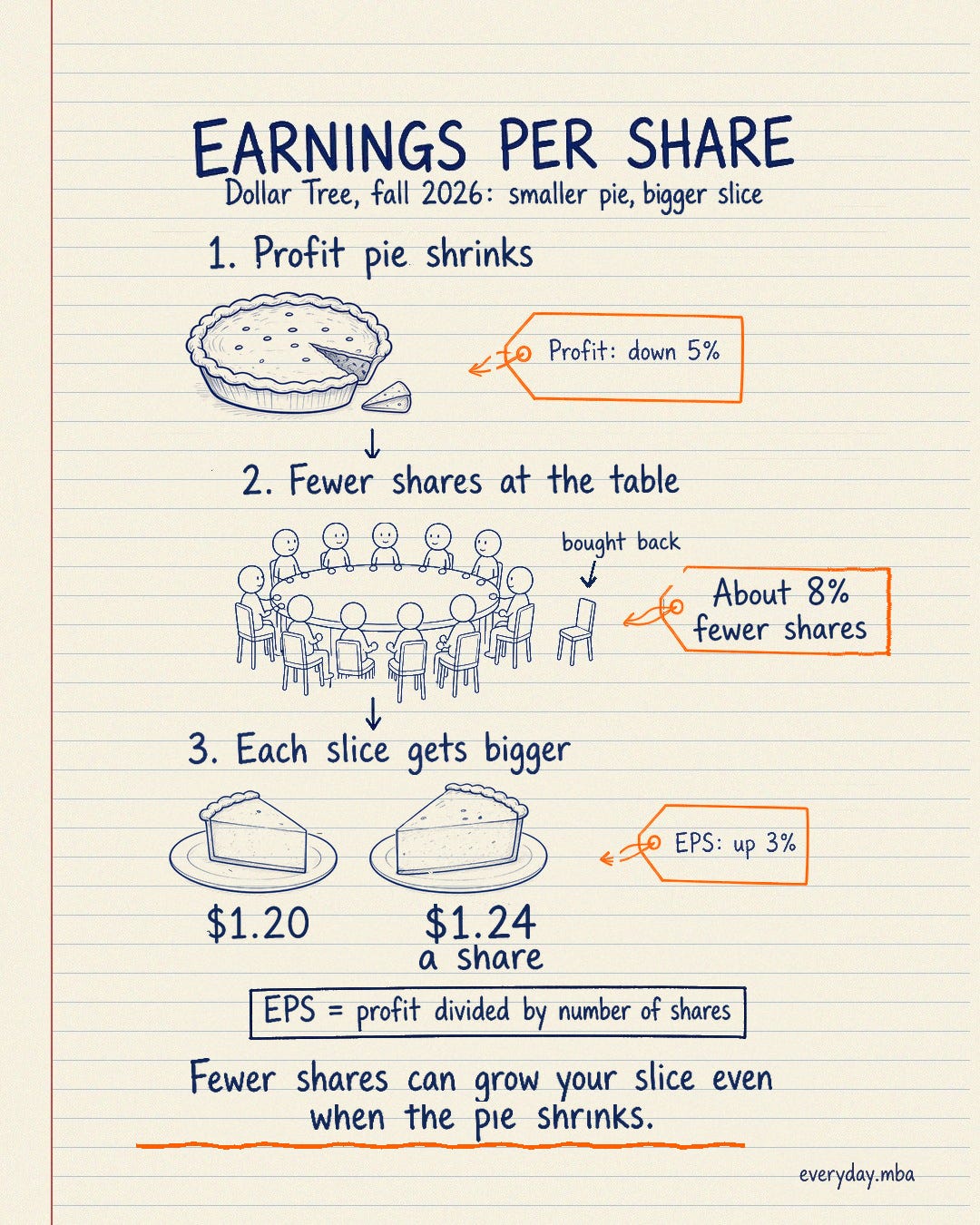
Dollar Tree has been doing the second one. When a company buys back its own stock, the shares it buys are no longer out there owning a piece of the profit, so every share that is left owns a bigger slice. Dollar Tree’s average share count last quarter was 187.6 million, down from 203.8 million a year earlier. That is about 8% fewer shares. So far this fiscal year it has bought back 12.9 million shares for $1.4 billion, including a $500 million block bought in June from shareholders who were selling, among them funds tied to the investment firm Mantle Ridge.
You can see the effect with simple math. Divide this quarter’s $232.0 million of profit by last year’s 203.8 million shares and you get about $1.14 a share. Divide it by today’s 187.6 million shares and you get $1.24. The business earned less. The buybacks turned a 5% drop in profit into a 3% gain per share.
Dollar Tree’s own adjusted numbers tell the same story. Those strip out an additional $18.3 million of insurance proceeds received last quarter, tied to a distribution center a tornado destroyed in Marietta, Oklahoma, in 2024. The company has recorded insurance gains from that event in several quarters since then. On that adjusted basis, income from continuing operations was $218.3 million, down 11.3% from $246.1 million a year earlier, while adjusted earnings per share fell 4.1%, to $1.16 from $1.21.
This matters because investors and analysts lean heavily on EPS. If you only read that one line, you might think the business got bigger. It did not. Each remaining share owns more of the business. That is real value for people who hold the stock, but it is not the same as the business earning more.
That is why the quality of a buyback comes down to two questions. The first is where the cash comes from. Last quarter Dollar Tree spent $205 million on buybacks, while its free cash flow, the cash left after paying for stores and equipment, was $122 million. The rest came from cash already on the books. It ended the quarter with $966 million of cash and no short-term borrowing from commercial paper or its credit line. That is not the same as having no debt. On March 19, 2026, Dollar Tree took out a $500 million term loan, and in June it bought back $500 million of stock in a single block. The year’s picture includes both the loan and that larger repurchase.
The second question is the price. Dollar Tree paid an average of $116 a share last quarter. That is a good use of money only if each share is worth more than $116 over time. If it is not, the company would have done better spending that cash elsewhere, like on its stores.
None of this makes the quarter bad. More shoppers came in, and the profit dip was partly a deliberate investment. Just read the per-share number and the total together.
How to Use It
1. Check both lines. Look at total profit and profit per share side by side. If they move in different directions, the share count is usually why.
2. Find the share count. Earnings reports list the average number of diluted shares, a count that includes stock options and other shares that could be issued. Compare it with the same quarter a year earlier.
3. Do the quick math. Divide this year’s profit by last year’s share count. That shows roughly what EPS would have been without the buybacks.
4. Ask where the cash came from. Buybacks paid for with spare cash are healthier than buybacks paid for with borrowed money or cash the business needs.
5. Use it outside the stock market. A team bonus pool split among fewer people, or a family business where one partner buys out another, works the same way. Your share can grow even when the total does not.
Sources
1. Dollar Tree, Inc., “Dollar Tree, Inc. Reports Third Quarter Results,” November 24, 2026. https://corporate.dollartree.com/investors/news-events/press-releases/detail/313/dollar-tree-inc-reports-third-quarter-results
2. Dollar Tree, Inc., Form 10-Q for the quarterly period ended October 31, 2026, U.S. Securities and Exchange Commission, November 24, 2026. https://www.sec.gov/Archives/edgar/data/935703/000093570326000137/dltr-20261031.htm
3. Dollar Tree, Inc., Form 8-K, Exhibit 99.1, “Dollar Tree, Inc. Reports Third Quarter Results,” U.S. Securities and Exchange Commission, November 24, 2026. https://www.sec.gov/Archives/edgar/data/935703/000093570326000136/ex991q3-26earningspressrel.htm
4. Quartz, “Dollar Tree beat sales expectations and raised its profit outlook,” November 24, 2026. https://qz.com/dollar-tree-sales-beat-raises-profit-outlook-112426