


The Story
On October 9, 2026, Delta Air Lines reported results for the quarter that ended September 30, the busy summer travel season. On the company’s adjusted basis, which strips out sales from its oil refinery and a few other items, revenue rose 16% to $17.6 billion, a record for the September quarter. Delta did it while flying almost exactly the same number of seats as a year earlier. Planes were 86% full in both years. The growth came from price: Delta earned 14% more for each mile a passenger flew.
The cost side moved faster. Since the Iran war began in February, jet fuel has surged. Delta’s adjusted fuel bill rose 62% to $4.1 billion, because the average price it paid jumped 60% to $3.61 a gallon while the amount it burned barely changed. Other costs, mostly crew pay and expenses tied to higher sales, rose $786 million. Put it together and Delta took in $2.39 billion more than a year ago, and its costs went up $2.42 billion. Adjusted operating income slipped $26 million to $1.66 billion. Pre-tax profit rose just $20 million, to $1.5 billion. Earnings per share were $1.72, against $1.70 a year ago and below the $1.76 analysts expected, according to LSEG data cited by Reuters.
The outlook took the bigger hit. Delta now expects full-year adjusted EPS of $5.10 to $5.60, down from the $6.50 to $7.50 it forecast in July, and free cash flow of about $2.5 billion instead of up to $4 billion. It says fuel will cost it $6 billion more this year. Asked what drove the cut, CFO Erik Snell told reporters, “All of it’s fuel.” Shares fell 3.5% in premarket trading, according to Reuters.
The Lesson
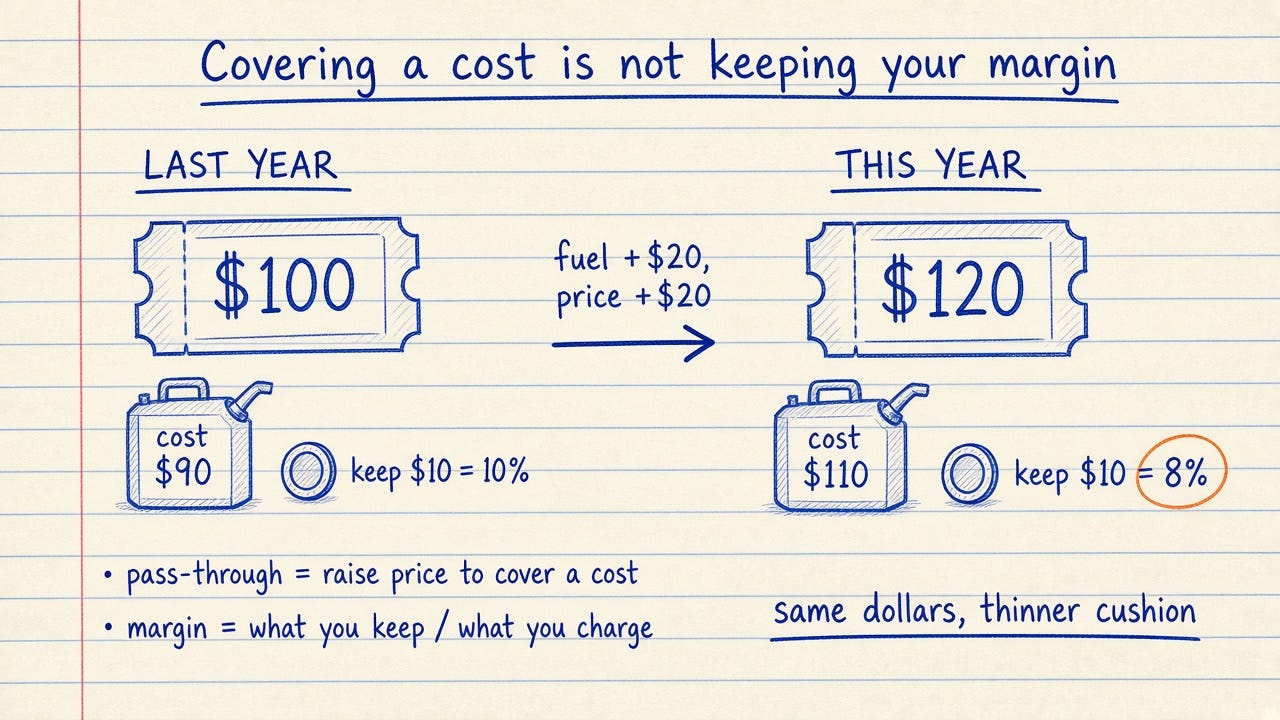
When a major cost jumps, the first question is whether you can pass it through, meaning raise your prices enough to cover it. Delta mostly could. Of every extra dollar of revenue it brought in, about 66 cents went to fuel and about 33 cents went to other costs. Customers paid for almost all of the spike, and profit in dollars held steady. That is real pricing power. Chief commercial officer Joe Esposito put it plainly, crediting “healthy yield growth as we cover higher costs and manage the business for margins.”
But covering a cost dollar for dollar does not protect your margin. Delta’s adjusted operating margin fell from 11.1% to 9.4%. The profit stayed the same size while the revenue around it grew, so each dollar of sales now keeps less. To hold the old 11.1% margin on this quarter’s costs, Delta would have needed about $330 million more in revenue, or growth of roughly 18% instead of 16%. Margin matters because it is your cushion. A thinner margin means the next surprise, a fare war, a weak holiday, another jump in oil, eats a bigger share of what is left.
The other trap is timing. Fuel is paid at today’s price, but fares are set weeks or months ahead. Delta says almost 60% of its fourth quarter is already booked, while it expects fuel to climb to about $4.25 a gallon. Deutsche Bank analysts, cited by Reuters, do not expect airlines to fully recover higher fuel costs until early 2027. Delta also has a partial offset its rivals lack: it owns a refinery that Snell expects to earn $700 million this year. That is a natural hedge, a business that makes more money when the thing that hurts you gets more expensive. Every business that buys a volatile input, coffee beans, steel, freight, electricity, faces the same race between its costs and its prices.
How to Use It
1. Measure pass-through in dollars. Compare how much revenue rose with how much the problem cost rose. If one is nearly as big as the other, you are covering the cost, not growing.
2. Then check the margin. Divide profit by revenue for both periods. If the percentage fell, work out how much more you would need to charge to get it back.
3. Map the lag. Write down how long it takes your prices to catch up with a cost change: open contracts, pre-sold orders, printed menus. That gap is where the damage happens.
4. Look for a natural hedge. Ask what part of your business, or which supplier deal, does better when your biggest cost rises. Even a partial offset buys time.
Sources
1. Delta Air Lines, “Delta Air Lines Announces September Quarter 2026 Financial Results,” press release (Exhibit 99.1 to Form 8-K, SEC EDGAR), October 9, 2026. https://www.sec.gov/Archives/edgar/data/27904/000002790426000035/deltaairlinesannouncessept.htm
2. Delta Air Lines, “Delta Air Lines Announces September Quarter 2026 Financial Results,” earnings release PDF, Delta News Hub, October 9, 2026. https://news.delta.com/sites/default/files/2026-10/delta-air-lines-announces-september-quarter-2026-results.pdf
3. Reuters (via BNN Bloomberg), “Delta Air cuts profit forecast as US$6 billion fuel-cost surge outweighs fare gains,” news article, October 9, 2026. https://www.bnnbloomberg.ca/business/company-news/2026/10/09/delta-air-cuts-profit-forecast-as-us6-billion-fuel-cost-surge-outweighs-fare-gains/
4. CNBC, “Delta Air Lines cuts 2026 forecast on fuel surge, but CEO says demand is still strong,” news article, October 9, 2026. https://www.cnbc.com/2026/10/09/delta-air-lines-dal-q3-2026-earnings.html
5. Delta News Hub, “Delta Air Lines announces September quarter 2026 financial results,” October 9, 2026. https://news.delta.com/delta-air-lines-announces-september-quarter-2026-financial-results