


The Story
On November 25, 2026, Deere & Company, the maker of John Deere tractors, combines and construction equipment, reported results for its fiscal year, which ended November 1. Total sales and revenues rose 4% to $47.7 billion. Net income slipped 3%, to $4.86 billion from $5.03 billion a year earlier.
The last quarter of the year was weaker. Sales of Deere’s big farm machines, the unit it calls Production & Precision Agriculture, fell 15% to $4.02 billion, and that unit’s operating profit fell 33% to $406 million. Smaller tractors, mowers and construction equipment sold more. For 2027, Deere expects net income of $4.50 billion to $5.25 billion, a range that includes a one-time pension charge of $0.25 billion to $0.40 billion. Quartz reported that the forecast came in below what analysts expected, and the stock slid before the market opened.
Deere’s chief executive, John May, said the company is working through “cyclical lows” and that its results are “structurally stronger compared with the same point in the last cycle.”
The Lesson
Some businesses rise and fall with a cycle much bigger than they are. Farmers buy new combines when crop prices and farm income are strong, and they keep the old ones running when money is tight. That makes Deere a cyclical company. Its sales and profit swing with the farm economy no matter how well it is run.
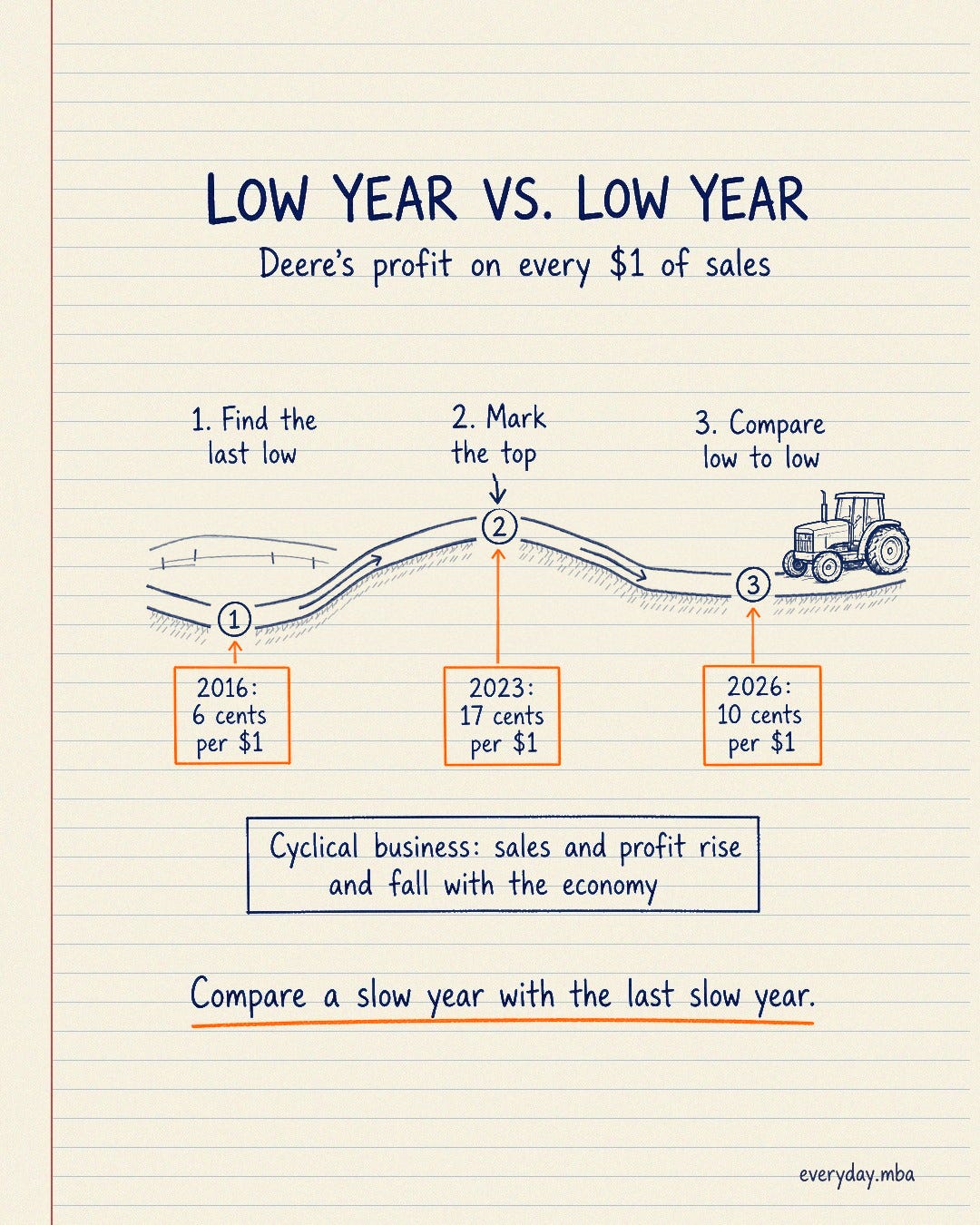
For a business like that, comparing this year with last year mostly tells you where you are in the cycle. A better test is to compare a low year with the last low year, and a high year with the last high year. That shows whether the business itself got stronger.
Deere’s own numbers make the case. In its last farm slump, which Deere called a “global farm recession,” profit hit its low in fiscal 2016. That year Deere earned $1.524 billion on $26.6 billion of sales and revenues, about 6 cents of profit for every dollar coming in. The next year profit climbed to $2.159 billion. In 2026, which Deere calls the bottom of this cycle, it earned $4.86 billion on $47.7 billion, about 10 cents for every dollar. At the low point, Deere now earns more than three times what it earned at the last low point.
The good years tell the other half. In fiscal 2023, a year of what Deere called “solid market conditions,” it earned $10.166 billion on $61.3 billion, about 17 cents for every dollar. From then to now, sales and revenues fell about 22%, but profit fell about 52%. Factories and engineers cost money whether orders come in or not, so profit falls harder than sales on the way down.
To be fair, 2026 got some help. Deere recorded $383 million of tariff recoveries this year. Even if you subtract all of it from net income, Deere still kept a little over 9 cents for every dollar, well above the 6 cents of its last low.
Headlines on a day like today are about one quarter and one forecast. But for an owner of a cyclical business, the bigger question is how much it earns when times are bad, because that decides whether it can keep investing and paying shareholders while it waits for the cycle to turn.
There are limits. A stronger low only pays off if the cycle turns, and Deere gave a wide 2027 range, citing “continued uncertainty in key end markets.” No two cycles are twins, either. That is why cents of profit per dollar of sales is a fairer yardstick than raw dollars: a company is usually bigger ten years later, and prices are higher too.
How to Use It
1. Ask whether the business is cyclical. If customers can easily put off the purchase, like a tractor, a car or a new roof, sales and profit will swing with the economy.
2. Find the last low and the last high. Look up the company’s results for those years. Old earnings releases stay online.
3. Compare cents per dollar, not just dollars. Divide profit by sales for each year. That puts a small year and a big year on the same footing.
4. Watch how hard profit falls compared with sales. When sales drop 22% and profit drops 52%, you know how sensitive the business is to the cycle.
5. Use it on your own work. If you earn commissions, sell homes or run a seasonal shop, judge a slow year against your last slow year, not your best one.
Sources
1. Deere & Company, “Deere Reports Net Income of $1.051 Billion for Fourth Quarter, $4.860 Billion for Fiscal Year,” PR Newswire, November 25, 2026. https://www.prnewswire.com/news-releases/deere-reports-net-income-of-1-051-billion-for-fourth-quarter-4-860-billion-for-fiscal-year-302950434.html
2. Deere & Company, Form 8-K, Exhibit 99.1, “Deere Reports Net Income of $2.369 Billion for Fourth Quarter, $10.166 Billion for Fiscal Year,” U.S. Securities and Exchange Commission, November 22, 2023. https://www.sec.gov/Archives/edgar/data/315189/000155837023019292/de-20231122xex99d1.htm
3. Deere & Company, Form 8-K, Exhibit 99.1, “Deere Reports Earnings of $285 Million for Fourth Quarter and $1.524 Billion for Year,” U.S. Securities and Exchange Commission, November 23, 2016. https://www.sec.gov/Archives/edgar/data/315189/000110465916158724/a16-21932_1ex99d1.htm
4. Deere & Company, Form 8-K, Exhibit 99.1, “Deere Reports Earnings of $510 Million for Fourth Quarter and $2.159 Billion for Year,” U.S. Securities and Exchange Commission, November 22, 2017. https://www.sec.gov/Archives/edgar/data/315189/000110465917070026/a17-27357_1ex99d1.htm
5. Quartz, “Deere’s 2027 profit outlook falls short of estimates in Q4 earnings,” November 25, 2026. https://qz.com/deere-profit-outlook-fiscal-2027-earnings-112526