


The Story
On November 23, 2026, CrowdStrike agreed to buy Zscaler in a deal valued at about $43.9 billion. Both companies sell cybersecurity software. CrowdStrike protects devices and cloud systems, and Zscaler protects the network connections between users, apps and AI agents. Together, CrowdStrike says, they can sell customers one platform that covers both.
CrowdStrike isn’t paying cash. For every Zscaler share, owners will get 1.135 CrowdStrike shares. Based on CrowdStrike’s closing price on Friday, November 20, that worked out to about $260.41 per Zscaler share, roughly 34% more than Zscaler’s own closing price that day. When the deal closes, today’s CrowdStrike owners are expected to hold about 84.1% of the combined company, and Zscaler owners about 15.9%.
Investors weren’t impressed. The same day, CrowdStrike reported a strong quarter, with revenue up 28% to $1.58 billion. Its stock still fell roughly 9%, according to CNBC, as investors worried about dilution, meaning each existing share would end up owning a smaller slice of the company. Zscaler’s stock rose more than 17%.
That 9% drop quietly changed the price of the deal. Zscaler owners are promised 1.135 CrowdStrike shares, not a set number of dollars. With each of those shares worth about 9% less, the offer was worth about $237 a share after one day of trading, not $260.41.
The Lesson
This is an all-stock deal, and the key term is the exchange ratio: how many of the buyer’s shares each of the seller’s shares turns into. Here the ratio, 1.135, is fixed. The dollar value isn’t. It rises and falls every day with the buyer’s stock until the deal closes.
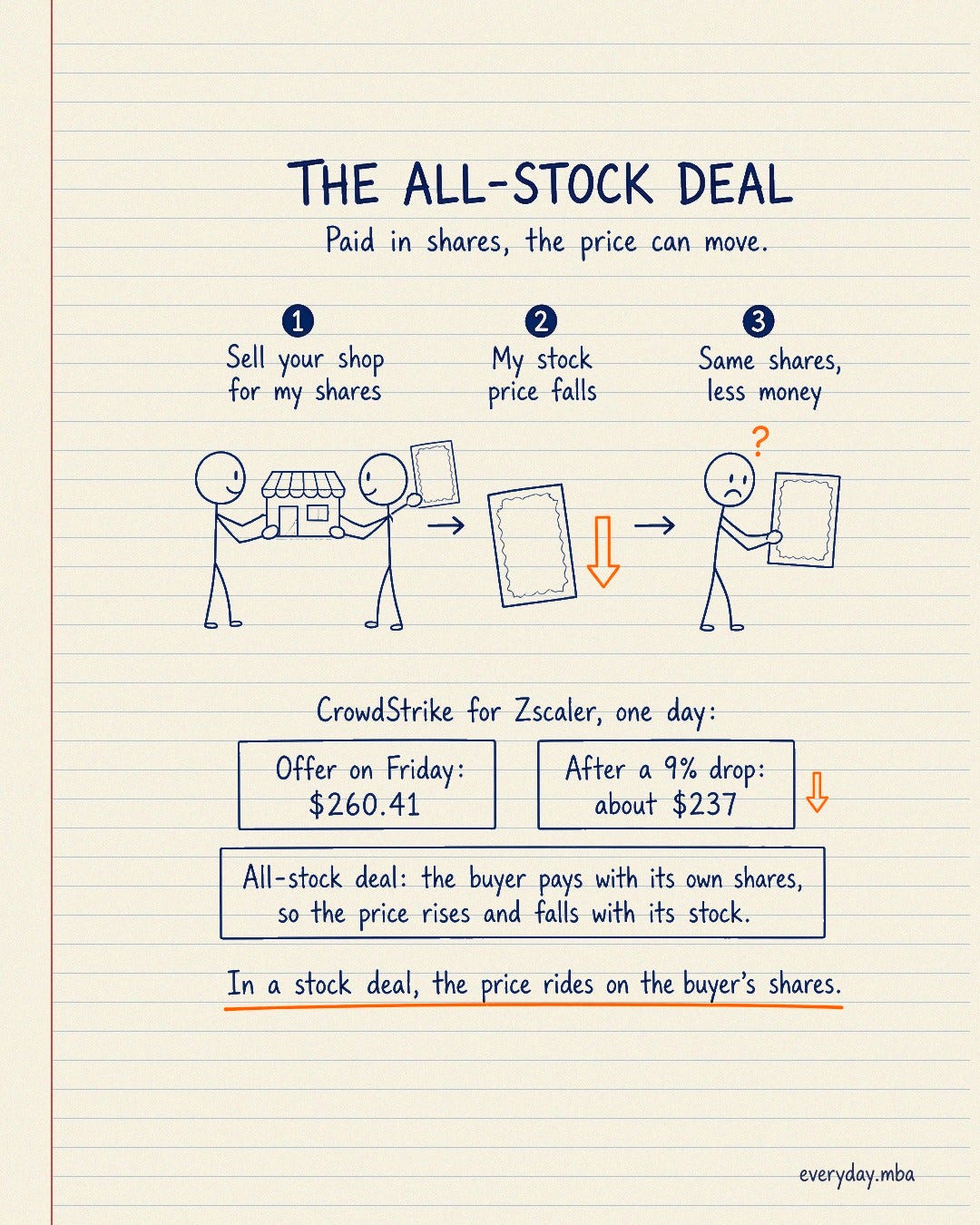
That changes who carries the risk. In a cash deal, the seller’s owners know exactly what they’ll get, and the buyer carries the risk of having paid too much. In a stock deal, both sides share it. If CrowdStrike’s stock climbs, Zscaler’s owners get more. If it slides, they get less. And after closing, they become CrowdStrike owners, so they keep riding the combined company’s ups and downs.
Paying in stock has a cost for the buyer’s owners, too. CrowdStrike will issue new shares, so its current owners go from owning all of CrowdStrike to about 84% of a bigger company. That trade only pays off if each share of the bigger company ends up worth more than a share of CrowdStrike would have been on its own. CrowdStrike’s case: it expects about $1 billion a year in extra revenue within 30 months of closing, from selling more to both companies’ customers, including about 8,000 Zscaler customers that don’t use CrowdStrike today. It also expects about $500 million a year in cost savings within 18 to 24 months. CEO George Kurtz told CNBC the deal will add to free cash flow per share right after closing. Those are targets, not results yet.
Time matters as well. The deal isn’t expected to close until the second half of CrowdStrike’s fiscal 2028, and it still needs regulators and Zscaler’s shareholders to approve it. Months of stock price swings sit between the handshake and the payday. The agreement tries to lock things in. Zscaler’s founder, Jay Chaudhry, and related holders, with about 34% of Zscaler’s shares, agreed to vote for it. And Zscaler would owe CrowdStrike a $1.4 billion fee in certain cases, such as walking away to take a better offer.
So an all-stock price tag is really a promise of shares, and shares move. The number in the headline is just the first day’s reading.
How to Use It
1. Read the deal in shares, not dollars. The headline price is a snapshot. Multiply the exchange ratio by the buyer’s current stock price to see what the offer is worth today.
2. Ask who carries the risk. Cash puts the risk on the buyer. Stock splits it between both sets of owners, before closing and after.
3. Check the ownership split. If you own the buyer, find out what slice you’ll keep. Here it’s about 84%. The deal has to make each share worth more, not just make the company bigger.
4. Separate cost savings from sales hopes. Cutting duplicate costs is mostly up to the company. Extra sales depend on customers choosing to buy more, so give those targets a little more doubt.
5. Watch the gap. If the seller’s stock trades below what the offer is worth that day, the gap is the market’s price for the wait and for the chance the deal falls apart.
Sources
1. CrowdStrike, “CrowdStrike to Acquire Zscaler, Bringing Network Security and Zero Trust to the Falcon Platform,” CrowdStrike Investor Relations, November 23, 2026. https://ir.crowdstrike.com/news-releases/news-release-details/crowdstrike-acquire-zscaler-bringing-network-security-and-zero/
2. CrowdStrike Holdings, Inc., Form 8-K (merger agreement with Zscaler), U.S. Securities and Exchange Commission, November 23, 2026. https://www.sec.gov/Archives/edgar/data/1535527/000110465926130785/tm2630454d1_8k.htm
3. CrowdStrike Holdings, Inc., Form 425 (third quarter key metrics and Zscaler deal highlights), U.S. Securities and Exchange Commission, November 23, 2026. https://www.sec.gov/Archives/edgar/data/1535527/000110465926131110/tm2630454d9_425.htm
4. CNBC, “CrowdStrike CEO defends Zscaler acquisition, calls it a ‘winning combination’,” November 23, 2026. https://www.cnbc.com/2026/11/23/crowdstrike-zscaler-deal-ceo-george-kurtz.html