


The Story
On October 6, 2026, Constellation Brands, the company behind Corona, Modelo, and Pacifico in the U.S., reported results for its fiscal second quarter, which ended August 31. Net sales rose 6% to $2.63 billion, ahead of the $2.54 billion analysts expected, according to LSEG data cited by Reuters. Comparable earnings per share, which exclude one-time items, were $3.74, beating the $3.56 estimate, and the company reaffirmed its full-year profit forecast. The stock still fell 4.5% in after-hours trading.
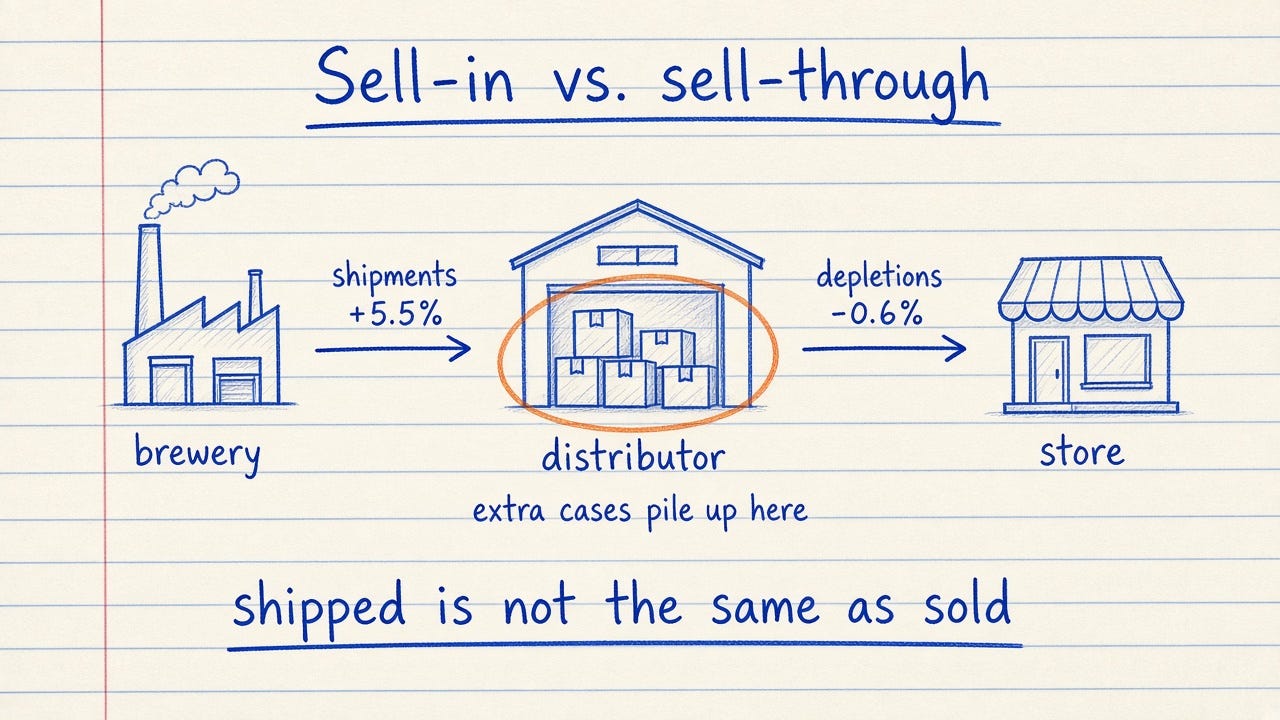
Part of the reason sits in two lines of the beer report. Constellation doesn’t sell beer to drinkers. Under the U.S. three-tier system, it sells mostly to wholesale distributors, which sell to stores, bars, and restaurants. So it reports two numbers: shipments, the cases it sends to distributors, and depletions, the cases distributors sell on to retailers. In the quarter, beer shipments rose 5.5% to 123.9 million cases (24-pack equivalents), and beer net sales rose 5% to $2.47 billion. Depletions fell 0.6%. Modelo Especial was down about 2% and Corona Extra about 5%, while Pacifico grew about 19% and Victoria about 15%.
Constellation said it “shipped slightly more cases than were depleted during the quarter as distributors ordered to rebuild inventory days on hand to healthier levels.” Last fiscal year went the other way: shipments fell 3.8% while depletions fell 2.1%, leaving distributors with thin stock. On the October 7 call, CEO Nicholas Fink said the company “entered FY27, frankly, too light” and had to ship “to close out distributor order backlogs and avoid out-of-stocks.” Over the first half, shipments rose 3.7% while depletions fell 0.5%. Fink expects the two to roughly match for the full year, and Yahoo Finance reported that investors were weighing whether the sales gain reflected restocking rather than more drinking.
The Lesson
When a company sells through a middleman, revenue measures what it sold to the middleman, not what customers bought. People in consumer goods call this sell-in versus sell-through. Sell-in is what you ship into the channel; sell-through is what the channel sells to the end customer. When sell-in runs ahead, the difference piles up as inventory in someone else’s warehouse. That can happen for good reasons, like refilling stock that ran too low, or bad ones, like pushing product out at quarter-end to hit a number. Either way, the gap has to close. A distributor holding extra cases orders fewer next time.
That’s why Constellation’s full-year forecast tells you more than its quarter. The company still expects beer net sales for the year to land between down 1% and up 1%. Beer net sales were $8.32 billion last fiscal year, and $4.76 billion came in the first half of this one, up 4%. To finish inside that range, second-half beer sales must fall somewhere between $3.47 billion and $3.64 billion, about 2.5% to 7% below last year’s second half of $3.74 billion. On the company’s own forecast, the first-half gain doesn’t add to the year. The second half gives most of it back.
Sell-in can flatter profit, too. Breweries carry heavy fixed costs, so pushing more cases through them lowers the cost of each case, and Constellation cited “favorable fixed cost absorption” in the quarter. Its CFO, Garth Hankinson, noted that the second half is the company’s lowest-volume period, with “less fixed cost absorption.” The number that reflects real demand is depletions, and there the trend is improving but still negative. The two biggest brands are shrinking while smaller ones grow, and management said September depletions were “trending in the right direction.” That line, more than the headline beat, is what investors focused on after the report. The same gap shows up anywhere a company sells through someone else, from consumer brands stocking retailers to software sold through resellers.
How to Use It
1. Find the number closest to the end customer. For a brewer, that’s depletions. For a consumer brand, it’s retailer sales data. For software sold through resellers, it’s active users or renewals. Compare it with reported sales every quarter.
2. Measure the gap and ask where it went. If shipments grow faster than sell-through, inventory is building somewhere. Ask how many weeks of supply the channel now holds compared with normal.
3. Read the full-year forecast backward. Subtract first-half results from the annual target to see what the second half implies. A strong first half with an unchanged forecast usually means a weaker second half.
4. Don’t fill the channel to make a quarter. Loading up distributors moves revenue forward and leaves a hole later. If your sales depend on resellers, track their stock levels and set orders by what they actually sell.
Sources
1. Constellation Brands, Inc., “Q2 Fiscal 2027 Earnings Release,” press release (Exhibit 99.1 to Form 8-K, SEC EDGAR), October 6, 2026. https://www.sec.gov/Archives/edgar/data/16918/000001691826000039/stzex991_83120268kearnings.htm
2. Constellation Brands, Inc., “Earnings Recap: Constellation Brands Second Quarter Fiscal Year 2027,” company earnings commentary, October 6, 2026. https://www.cbrands.com/blogs/stories/earnings-recap-constellation-brands-second-quarter-fiscal-2027-earnings-results
3. Constellation Brands, Inc., “Q4 Fiscal 2026 Earnings Release,” press release (Exhibit 99.1 to Form 8-K, SEC EDGAR), April 8, 2026. https://www.sec.gov/Archives/edgar/data/16918/000001691826000008/stzex991_22820268kearnings.htm
4. Benzinga, “Transcript: Constellation Brands Q2 2027 Earnings Conference Call,” earnings call transcript, October 7, 2026. https://www.benzinga.com/news/26/10/62215391/transcript-constellation-brands-q2-2027-earnings-conference-call
5. Reuters (via MarketScreener), “Corona beer maker Constellation Brands tops second-quarter estimates on resilient demand,” news article, October 6, 2026. https://www.marketscreener.com/news/corona-beer-maker-constellation-brands-tops-second-quarter-estimates-on-resilient-demand-ce785dd9df88f527
6. Yahoo Finance, “Constellation Brands stock sinks as beer sales demand faces durability question,” news article, October 7, 2026. https://finance.yahoo.com/markets/stocks/article/constellation-brands-stock-sinks-as-beer-sales-demand-faces-durability-question-122908715.html