


The Story
On November 12, 2026, Cisco, the San Jose company best known for the switches and routers that move data around offices and data centers, reported its fiscal first quarter, the three months ended October 24. Revenue was a record $18.5 billion, up 24% from $14.9 billion a year earlier. Analysts had expected about $18.1 billion.
Almost all of that growth came from products. Product revenue rose 32% to $14.7 billion, led by networking, up 43%, as cloud companies bought Cisco gear for AI data centers. Services revenue, mostly support contracts, grew just 1% to $3.9 billion.
Here is the odd part. Cisco’s gross margin, the share of each sales dollar left after the cost of what it sold, fell from 65.5% to 63.7%. But gross profit in dollars rose from $9.7 billion to $11.8 billion. That is about $2 billion more, up 21%. Operating income rose 66% to $5.6 billion, and Cisco raised its forecast for the full year.
The Lesson
When a margin percentage falls while the business grows, check the sales mix before you call it bad news. The mix is the blend of things a company sells. Each piece earns a different margin, so the company-wide percentage is really an average. Sell more of the lower-margin piece and the average drops, even if nothing got worse.
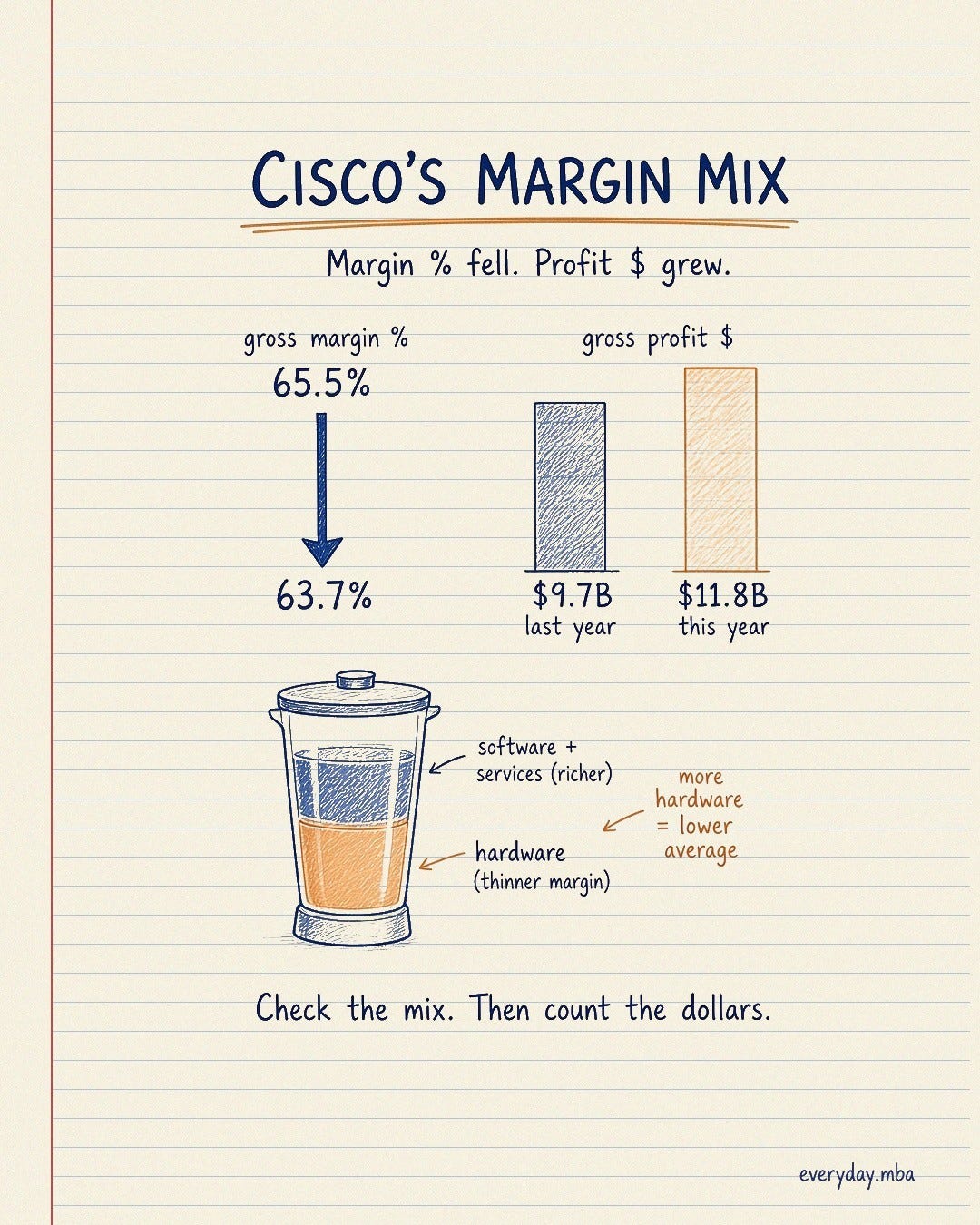
That is a big part of Cisco’s story. Its chief financial officer said hardware grew much faster than software and services, which earn higher margins. Services earned 68.4% a year ago and 70.9% this quarter. Hardware carries thinner margins, and AI networking gear is the fastest-growing hardware Cisco sells. Cisco expects AI sales to the biggest cloud companies to reach about 12% of revenue this fiscal year, up from 6% last year.
Mix is not the whole story, though. Cisco’s product margin fell from 64.5% to 61.8%. The CFO pointed to two causes: more hardware inside the product line, and higher memory chip costs, partly offset by price increases and efficiency gains. The mix part comes with Cisco’s push into AI data centers. The memory part is a cost that could rise or fall from here.
So is a 63.7% margin a problem? Not while the dollars keep growing. Cisco’s operating margin rose to 30.2% from 22.6%, because operating expenses fell 3% while sales jumped. You can’t spend a percentage. You can spend gross profit dollars, and Cisco has $2 billion more of them.
The risk is assuming the mix stays this friendly. Big AI orders come from a few very large buyers, and they can slow down as fast as they sped up.
How to Use It
1. Split the change. Recalculate this year’s margin using last year’s margin for each line and this year’s mix. For Cisco, that gives about 65.3%, versus 65.5% a year ago. So the shift from services toward products explains only about 0.2 points. The rest happened inside the product line.
2. Follow the dollars. A lower margin on much bigger sales can still mean more gross profit. Ask whether gross profit dollars grew, not just whether the percentage moved.
3. Ask what is growing fastest. If your fastest-growing product has the thinnest margin, your average margin will fall even if every product is doing fine.
4. Separate mix from cost. Mix comes from what you choose to sell. Input costs, like Cisco’s memory chips, are mostly outside your control. They call for different responses.
5. Watch customer concentration. Low-margin growth from a few big buyers is worth less than it looks if those buyers can stop ordering.
6. Use it at work. When your team’s margin dips, show the mix and the dollars together, so leaders can see whether you sold worse or just sold more of something different.
Sources
1. Cisco, “Cisco Reports First Quarter Earnings,” November 12, 2026. https://newsroom.cisco.com/c/r/newsroom/en/us/a/y2026/m11/cisco-reports-first-quarter-earnings.html
2. The Motley Fool, “Cisco (CSCO) Q1 2027 Earnings Call Transcript,” November 13, 2026. https://www.fool.com/earnings/call-transcripts/2026/11/13/cisco-csco-q1-2027-earnings-call-transcript/
3. CNBC, “Cisco beats on earnings, says AI infrastructure revenue will double this fiscal year,” November 12, 2026. https://www.cnbc.com/2026/11/12/cisco-csco-q1-2027-earnings.html