



A big premium to last week’s stock price can still leave sellers far below where the company once traded, so always pair the deal premium with the peak valuation.
The Story
On October 13, 2026, Bumble announced that it had agreed to be acquired by Ithaca Holdings in an all-cash deal valuing the company at $1.3 billion. Shareholders will receive $6.05 per share of Class A common stock. The company says that price is about a 138% premium to the unaffected closing share price on October 9, 2026, and about a 119% premium to the 30-day volume-weighted average price as of that date. The merger agreement was signed October 12. After closing, Bumble will go private, and Ithaca’s co-CEOs, Ravi Gupta and John Hegeman, will become co-CEOs alongside founder Whitney Wolfe Herd, who will stay actively involved.
An independent Special Committee of the board reviewed strategic alternatives with its own advisors, recommended the deal, and the board approved it—Wolfe Herd recused herself. Affiliates of Blackstone and Wolfe Herd then approved it by written consent, supplying the needed shareholder vote. Bumble will file an information statement and skip a third-quarter earnings call; it still expects to file its Form 10-Q by November 9, 2026.
The operating backdrop helps explain why a take-private was on the table. In the second quarter that ended June 30, 2026, Bumble’s total revenue fell 15.2% to $210.5 million from $248.2 million a year earlier. Total paying users fell 16.4% to about 3.2 million from 3.8 million. Adjusted EBITDA was still $72.9 million, but Bumble also recorded a $169.3 million impairment charge tied to a sustained drop in its stock price. After its February 2021 IPO, its valuation once topped $14 billion, according to contemporaneous reporting. A $1.3 billion exit is a jump from last week’s close—and a steep comedown from that peak.
The Lesson
An acquisition premium and a peak valuation answer different questions. The premium tells you how much better the offer is than the recent public price—here, roughly double-plus the unaffected October 9 close. That is useful if you owned the stock last week and want to know what the buyer is paying above the market that was available without a deal. It does not tell you how the sale compares with what investors once believed the business was worth. Peak valuation answers that. When a company later sells for a fraction of its high, a “generous” premium can still crystallize a large absolute loss for anyone who bought near the peak. The math is simple: $1.3 billion is about one-tenth of a $14 billion peak. Both can be true at once. Ithaca is paying well above last week’s price; holders who rode the decline still exit far below the IPO-era mark.
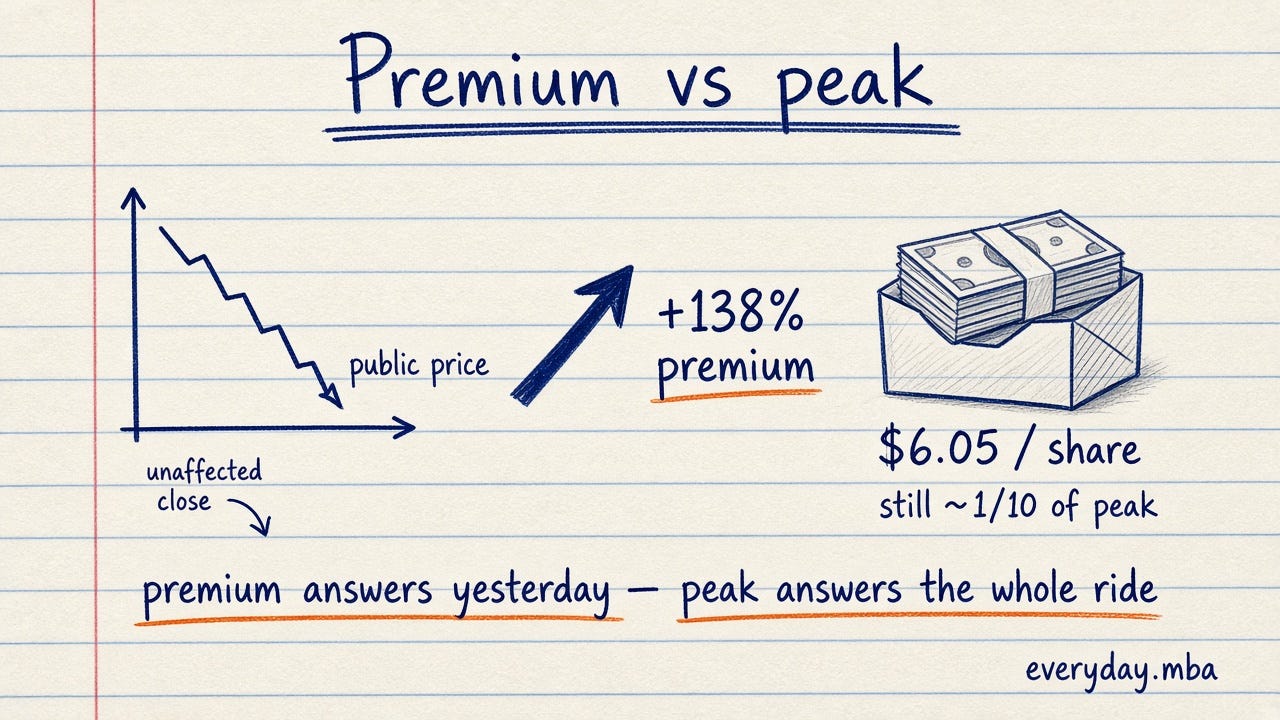
Going private often follows this pattern. Public markets price a company every day and punish weak user and revenue trends quickly. A turnaround that needs product experiments or a new format may take longer than quarterly patience allows. Private ownership does not fix declining paying users by itself, but it can change the scoreboard: fewer mark-to-market shocks and more room to invest without explaining every soft quarter. The Special Committee’s job was to test whether that path, at this cash price, beat staying public. The premium answers relative to yesterday’s stock. The gap to peak shows how far the public story had already fallen.
How to Use It
1. Write two numbers side by side on every deal. Note the premium to the unaffected price (or to a VWAP) and the deal value as a percent of the company’s peak market cap or IPO-era valuation. Celebrate neither number alone.
2. Ask what the premium is compensating for. A large premium often appears when the stock has already sunk. Check the last few quarters of revenue, users, and impairments so you know whether the “win” is mainly relief from a beaten-down quote.
3. Separate the exit from the turnaround. Going private can buy time. It does not by itself reverse a 15% revenue drop or a 16% slide in paying users. Track the operating metrics the same way after the deal that you did before it.
4. Use the same lens on your own business. If you are selling a company, a product line, or even a house, ask both: “Is this a good price versus the market this week?” and “How does it compare with the high-water mark?” Price the gap before you call the premium a victory.
Sources
1. Bumble Inc., “Bumble Inc. to Be Acquired by Ithaca Holdings, the Long-Term Holding Company for Enduring Technology Businesses,” press release, October 13, 2026. https://ir.bumble.com/news/news-details/2026/Bumble-Inc--to-Be-Acquired-by-Ithaca-Holdings-the-Long-Term-Holding-Company-for-Enduring-Technology-Businesses/default.aspx
2. Bumble Inc., Form 8-K (Item 1.01), filed October 13, 2026 (SEC EDGAR). https://www.sec.gov/Archives/edgar/data/1830043/000095010326015480/0000950103-26-015480-index.htm
3. Bumble Inc., Exhibit 99.1 to Form 8-K (press release), filed October 13, 2026 (SEC EDGAR). https://www.sec.gov/Archives/edgar/data/1830043/000095010326015480/dp254907_ex9901.htm
4. Bumble Inc., “Bumble Inc. Announces Second Quarter 2026 Results,” press release / Exhibit 99.1, August 5, 2026. https://www.sec.gov/Archives/edgar/data/1830043/000183004326000099/bmbl-ex991prxq22026.htm
5. Bumble Inc., Form 10-Q for the quarterly period ended June 30, 2026, filed with the SEC. https://www.sec.gov/Archives/edgar/data/1830043/000183004326000104/bmbl-20260630.htm
6. BBC News, “Bumble bought for $1.3bn in ‘bet on the future of humanity’,” October 13, 2026. https://www.bbc.com/news/articles/cm9qzwjgnjxlo