



The Story
On October 27, 2026, Boeing reported results for its third quarter ended September 30. The headline number was huge: a record $745 billion backlog. A backlog is the total value of orders a company has signed but not yet delivered.
Most of that, $612 billion, sits in Commercial Airplanes, covering more than 6,300 jets. Airlines placed 300 net new orders in the quarter alone, including orders from Turkish Airlines, Ethiopian Airlines and Lufthansa. Total backlog is up $63 billion since the end of 2025.
But the same unit that holds most of the backlog lost money. Commercial Airplanes delivered 161 planes and brought in $10.7 billion of revenue, yet posted a $697 million operating loss, a margin of negative 6.5%. Boeing pointed to a less favorable mix of deliveries, higher projected costs tied to future production rate changes, and higher estimated supply chain costs.
The smallest backlog told a different story. Global Services, which handles parts, maintenance and support, has a $33 billion backlog. It earned $1.02 billion on $5.6 billion of revenue, an 18.3% margin.
For the whole company, revenue was $24.2 billion and operating margin was just 1.5%.
The Lesson
A backlog measures demand. It doesn’t measure profit. It tells you how much work is lined up, not whether that work will make money.
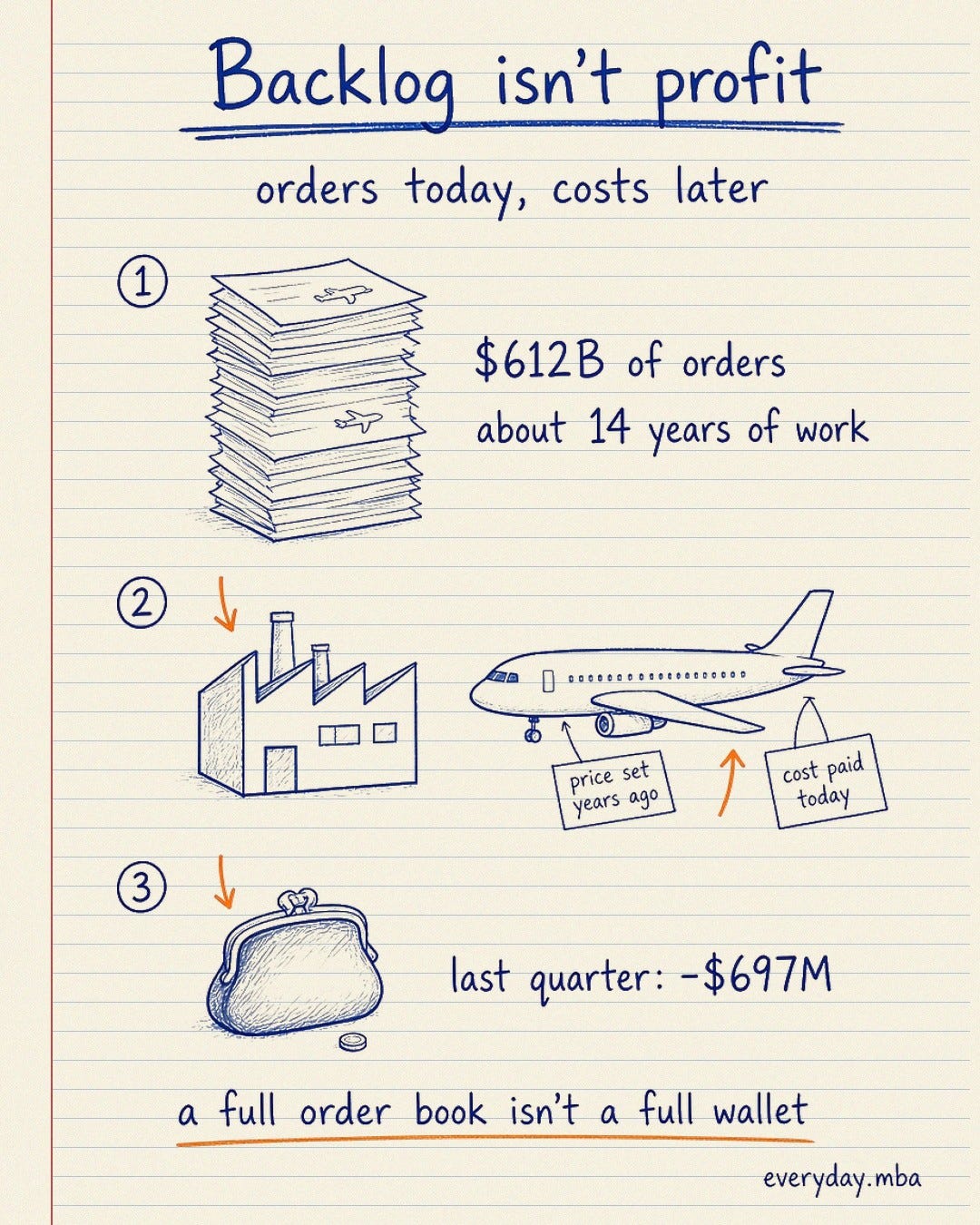
Start with the size. Commercial Airplanes’ revenue last quarter works out to about $43 billion a year. Divide the $612 billion backlog by that, and it’s roughly 14 years of work at today’s pace. For the whole company, it’s nearly eight years. That kind of visibility is rare, and it’s a real strength. Customers have committed, and many pay deposits years before delivery.
Now look at what the backlog is worth. Airplane prices are usually set when the order is signed, often years ahead. Costs are paid when the plane is built. Escalation clauses can pass some cost increases on to the buyer, but if labor, parts or supply chain costs rise faster than those clauses allow, the margin on that order shrinks. A long backlog locks in revenue. It can also lock in thin margins.
That is why Global Services matters so much. Its backlog is tiny next to Commercial Airplanes, only about 18 months of its revenue. But last quarter it earned $1.02 billion while the airplane unit lost $697 million. The smaller order book is doing the heavy lifting on profit.
Finally, check what counts. Boeing splits its backlog into about $693 billion of contractual orders and $53 billion it calls unobligated, government contracts whose funding hasn’t been authorized yet. And the Navy’s new F/A-XX fighter award isn’t included at all while a review is pending. Two companies can report backlog differently, so read the footnotes.
How to Use It
1. Translate backlog into time. Divide backlog by annual revenue to see how many years of work are lined up. A number in years is easier to judge than a number in billions.
2. Ask what margin the backlog carries. A full order book at a loss is a long, guaranteed loss. Look for the segment margin next to the backlog figure.
3. Watch the gap between pricing and cost. The longer the backlog, the more exposed it is to rising costs. Ask how much of a cost increase the contracts let you pass on to customers.
4. Separate firm from soft. Split contractual orders from options, unfunded work or pending awards. Only the firm part is close to guaranteed revenue.
5. Apply it to your own work. A packed pipeline feels like success. Before you celebrate, ask which of those deals will actually make money once you deliver them.
Sources
1. Boeing, “Boeing Reports Third Quarter Results,” news release, October 27, 2026. https://investors.boeing.com/investors/news/press-release-details/2026/Boeing-Reports-Third-Quarter-Results/default.aspx
2. The Boeing Company, Form 8-K, filed October 27, 2026 (SEC EDGAR). https://www.sec.gov/Archives/edgar/data/12927/000162828026067411/0001628280-26-067411-index.htm
3. The Boeing Company, Exhibit 99.1 to Form 8-K (third-quarter 2026 earnings release, including segment results and total backlog), filed October 27, 2026 (SEC EDGAR). https://www.sec.gov/Archives/edgar/data/12927/000162828026067411/a202609sep308kprex991.htm