


The Story
On November 2, 2026, Backblaze reported results for its third quarter ended September 30. Backblaze stores data for other people. It sells two things: B2 Cloud Storage, used by businesses and AI companies, and Computer Backup, which backs up people’s laptops and desktops.
Total revenue was $46.7 million, up 26% from a year earlier. But the two businesses went in opposite directions. B2 revenue rose 47%, to $30.5 million. Computer Backup revenue fell 2%, to $16.2 million.
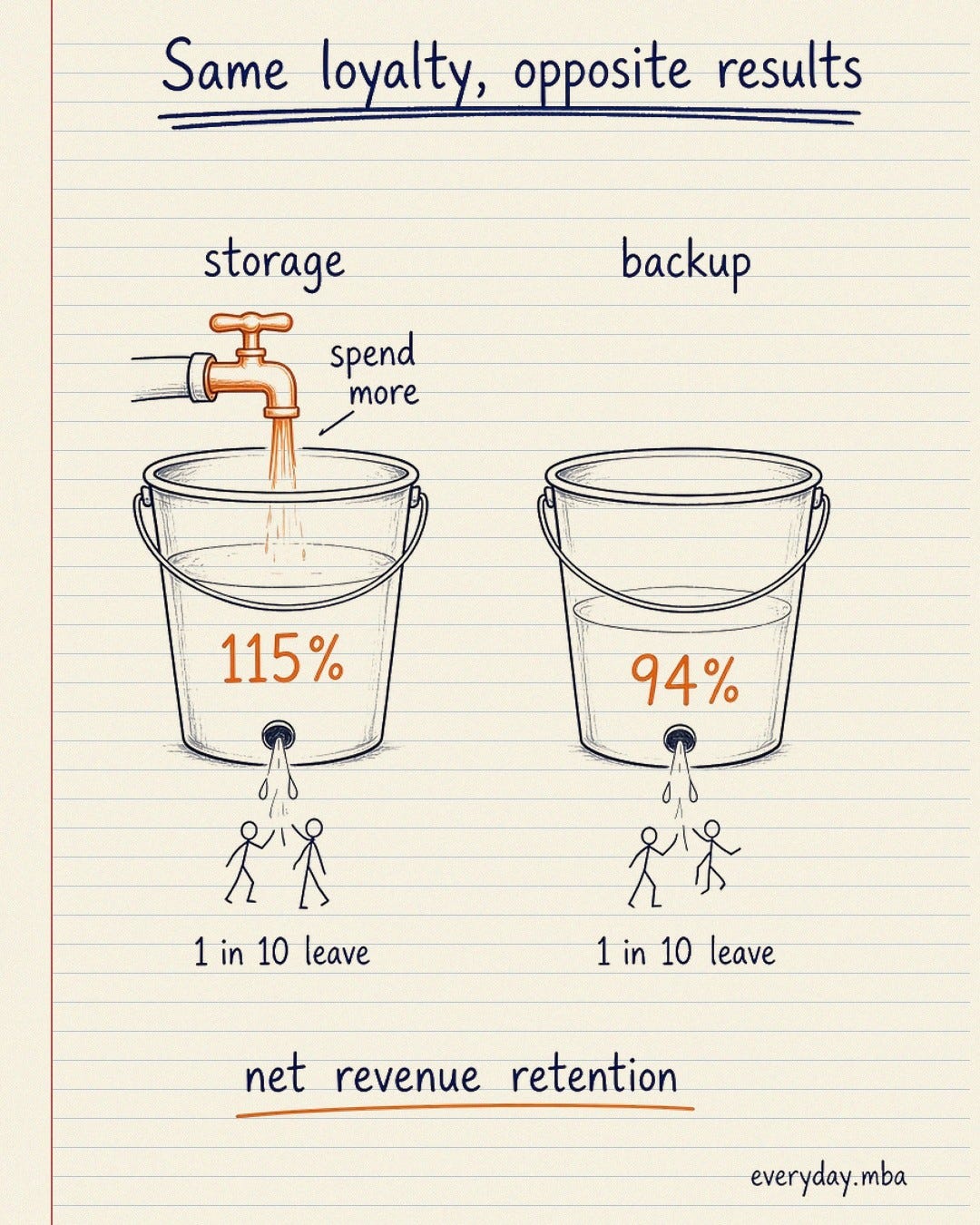
Here’s the interesting part. Both businesses hold on to customers about equally well. B2’s gross customer retention rate was 89%. Computer Backup’s was 91%. So the backup business actually keeps slightly more of its customers.
The difference is what those customers do after they stay. B2’s net revenue retention rate was 115%. Computer Backup’s was 94%. For the whole company, it was 105%, down from 107% a year earlier.
CEO Gleb Budman pointed to new customers too. Net new B2 self-serve customers hit a record, four times as many as a year ago. Backblaze raised its full-year revenue outlook to about $178 million.
The Lesson
There are two ways to measure whether customers stick. They answer different questions.
Gross customer retention counts heads. Of the accounts paying a year ago, how many are still paying? Backblaze says this number “reflects only customer losses.” It ignores whether the customers who stayed spend more or less.
Net revenue retention (NRR) counts dollars. Take the customers you had a year ago. Compare what they pay you now with what they paid then. Upgrades and extra usage push it up. Downgrades and lost customers push it down. New customers are left out on purpose.
An NRR above 100% means your existing customers, as a group, pay you more than they did last year, even after the ones who left. Below 100%, the group shrinks and you need new customers just to stand still.
Backblaze shows the gap clearly. Storage is a product that grows by itself. A company that keeps 10 terabytes this year often keeps 15 next year. So the B2 customers who stayed spent enough extra to more than cover the roughly 11% who left. That’s how you get 115%.
Backing up a laptop doesn’t grow like that. One computer is one computer. So when about 9% of backup customers leave, the ones who stay can’t make up for them. Revenue from last year’s group drifts down to 94%.
Same loyalty. Opposite results. The difference is expansion.
The catch: NRR can rise for reasons that aren’t about customers loving the product more. Price increases lift it too. Backblaze raised its pay-as-you-go storage prices on May 1, 2026. Higher prices can boost NRR for a while, even if usage doesn’t grow. And a few big customers growing fast can carry the average.
How to Use It
1. Read both numbers together. Gross retention tells you if customers leave. Net retention tells you if the ones who stay grow.
2. Find the 100% line. Above it, existing customers are a growth engine. Below it, you’re refilling a leaky bucket with new sales.
3. Ask where expansion comes from. More usage and upgrades are healthy. Price increases can fade.
4. Split by product. A company-wide 105% can hide one product at 115% and another at 94%.
5. Use it at work. Any business with repeat customers can run this. Take last year’s customers and compare their spending now with then. You’ll learn more than a customer count alone tells you.
Sources
1. Backblaze, Inc., “Backblaze Announces Third Quarter 2026 Financial Results,” Exhibit 99.1 to Form 8-K, November 2, 2026 (SEC EDGAR). https://www.sec.gov/Archives/edgar/data/1462056/000162828026068866/ex991blze20260930earningsp.htm
2. Backblaze, Inc., Form 8-K filing index, November 2, 2026 (SEC EDGAR). https://www.sec.gov/Archives/edgar/data/1462056/000162828026068866/0001628280-26-068866-index.htm
3. Backblaze, Inc., investor relations press release, November 2, 2026. https://ir.backblaze.com/news/news-details/2026/Backblaze-Announces-Third-Quarter-2026-Financial-Results/default.aspx