


The Story
On November 3, 2026, Amgen reported results for its third quarter ended September 30. Amgen is one of the world’s biggest biotech companies. It makes medicines like Repatha, a cholesterol drug, and Prolia, a bone drug.
On the income statement, it was a great quarter. Total revenue rose 8%, to $10.4 billion. Net income rose 20%, from $3.2 billion to $3.9 billion. Earnings per share rose 19%, to $7.08.
Then look at the cash flow statement. Cash from operations fell 9%, from $4.7 billion to $4.2 billion. Free cash flow, which is operating cash minus spending on factories and equipment, fell 14%, from $4.2 billion to $3.7 billion.
So profit went up by about $650 million. Cash went down by about $600 million. Same company, same three months.
Amgen explained the gap in one line. The drop was “driven by changes in working capital, with the third quarter of 2025 benefiting from the timing of rebates and collections.”
The Lesson
Profit and cash measure different things. Profit tells you what a company earned. Cash tells you what actually landed in the bank.
Accounting records a sale when the medicine ships, not when the customer pays. If a company sells $100 of product but hasn’t collected yet, profit goes up by the margin on that sale. Cash doesn’t move until the check clears.
The money tied up in that waiting period is called working capital. It’s mostly three things: money customers owe you (receivables), product sitting in warehouses (inventory), and money you owe suppliers (payables).
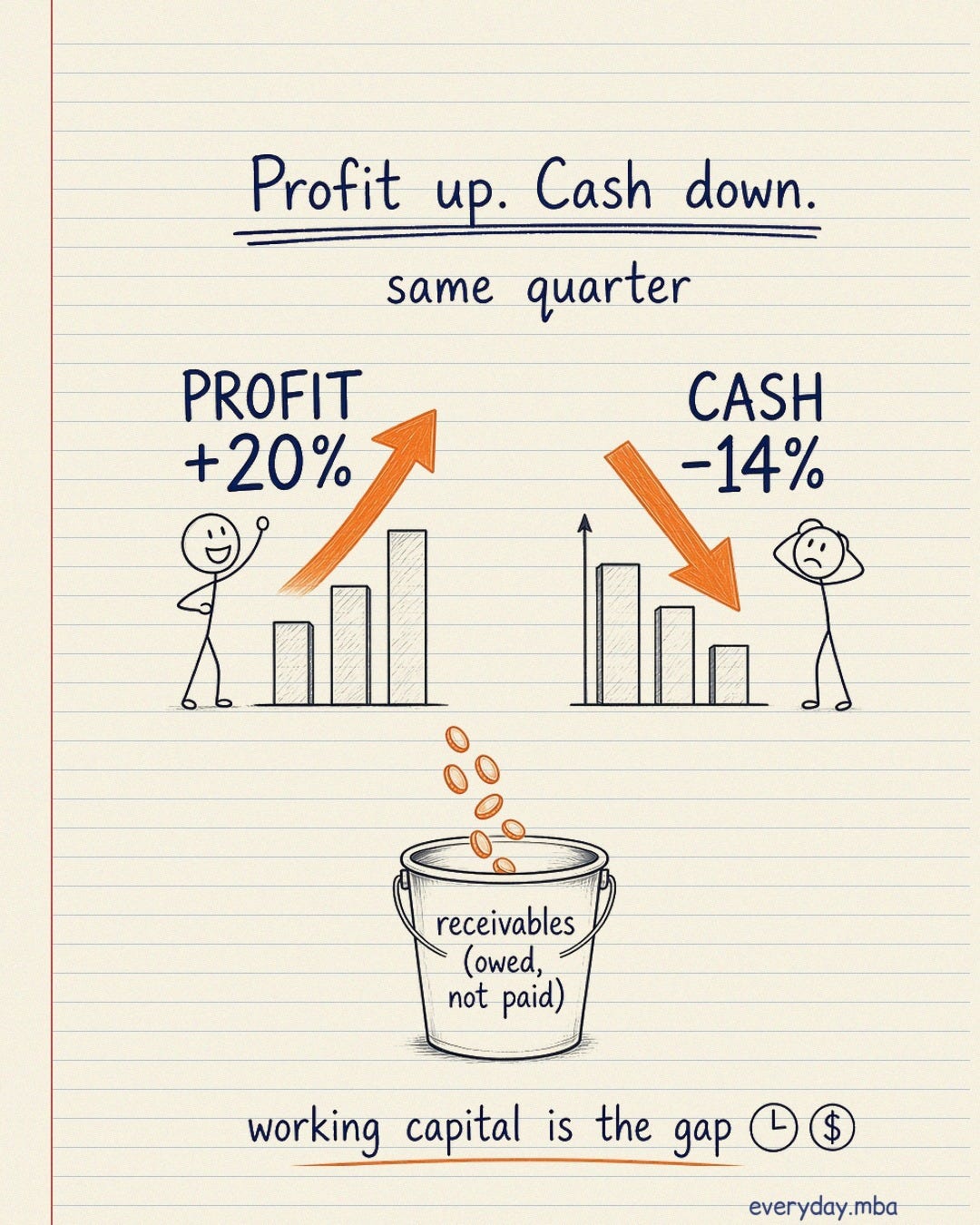
When receivables and inventory grow faster than payables, cash gets stuck. When they shrink, cash gets released. Amgen’s receivables rose from $9.6 billion at the end of 2025 to $10.4 billion on September 30. That’s about $800 million earned but not yet collected.
Timing works both ways. Amgen says last year’s quarter got a boost from when rebates were paid and bills were collected. So part of this year’s drop is just a tough comparison, not a problem.
There’s a second gap worth noticing. Amgen’s net income included about $1.5 billion of gains on stock it owns in other companies. Those gains raise profit, but no cash comes in unless the shares are sold.
The catch: a cash dip isn’t automatically bad news. Year to date, Amgen’s free cash flow is $8.6 billion, up from $7.1 billion a year earlier. One quarter of timing can swing either way. The warning sign is when profit keeps rising and cash keeps lagging, quarter after quarter.
How to Use It
1. Read two statements, not one. Check the income statement for profit and the cash flow statement for cash. They should tell roughly the same story over time.
2. Compare the growth rates. If profit grows 20% and cash falls 14%, ask why before you celebrate.
3. Look at receivables. If customers owe you more and more, you’re funding their purchases with your money.
4. Strip out non-cash gains. Gains on investments can lift profit without adding a dollar to the bank.
5. Zoom out. Look at year-to-date or a full year. One quarter can be timing. A trend is a signal.
6. Use it at work. If your team books a big deal on 90-day payment terms, the win shows up in this quarter’s numbers. The cash shows up next quarter. Plan for that gap.
Sources
1. Amgen, “Amgen Reports Third Quarter 2026 Financial Results,” press release, November 3, 2026. https://www.amgen.com/newsroom/press-releases/2026/11/amgen-reports-third-quarter-2026-financial-results