


The Story
On November 5, 2026, Airbnb reported results for its third quarter, which ended September 30. Revenue hit $4.9 billion, up 19% from a year earlier. Gross Booking Value, the total value of stays and services booked on the platform, rose 21% to $27.7 billion. Nights and Seats Booked grew 16% to 155 million. Adjusted EBITDA rose 22% to $2.5 billion, a 52% margin.
The company also raised its full-year 2026 outlook. It now expects revenue growth in the “high teens,” up from “at least mid-teens” earlier. CEO Brian Chesky told investors the company is “back in growth mode.”
Buried in that growth story is a smaller product that matters for a different reason: hotels. Airbnb now lists thousands of boutique and independent hotels across more than 60 top destinations. Hotels are still only a single-digit share of total nights booked. Chesky said hotel bookings are growing “markedly faster” than the core home-rental business.
And here is the number that turns a side category into a strategy: about 35% of guests whose first Airbnb booking is a hotel come back later to book a home. That figure covers hotel bookers from October 2024 through September 2025 who returned for a home within the next 365 days.
The Lesson
A new product line can look small on the scoreboard and still do important work for the core business.
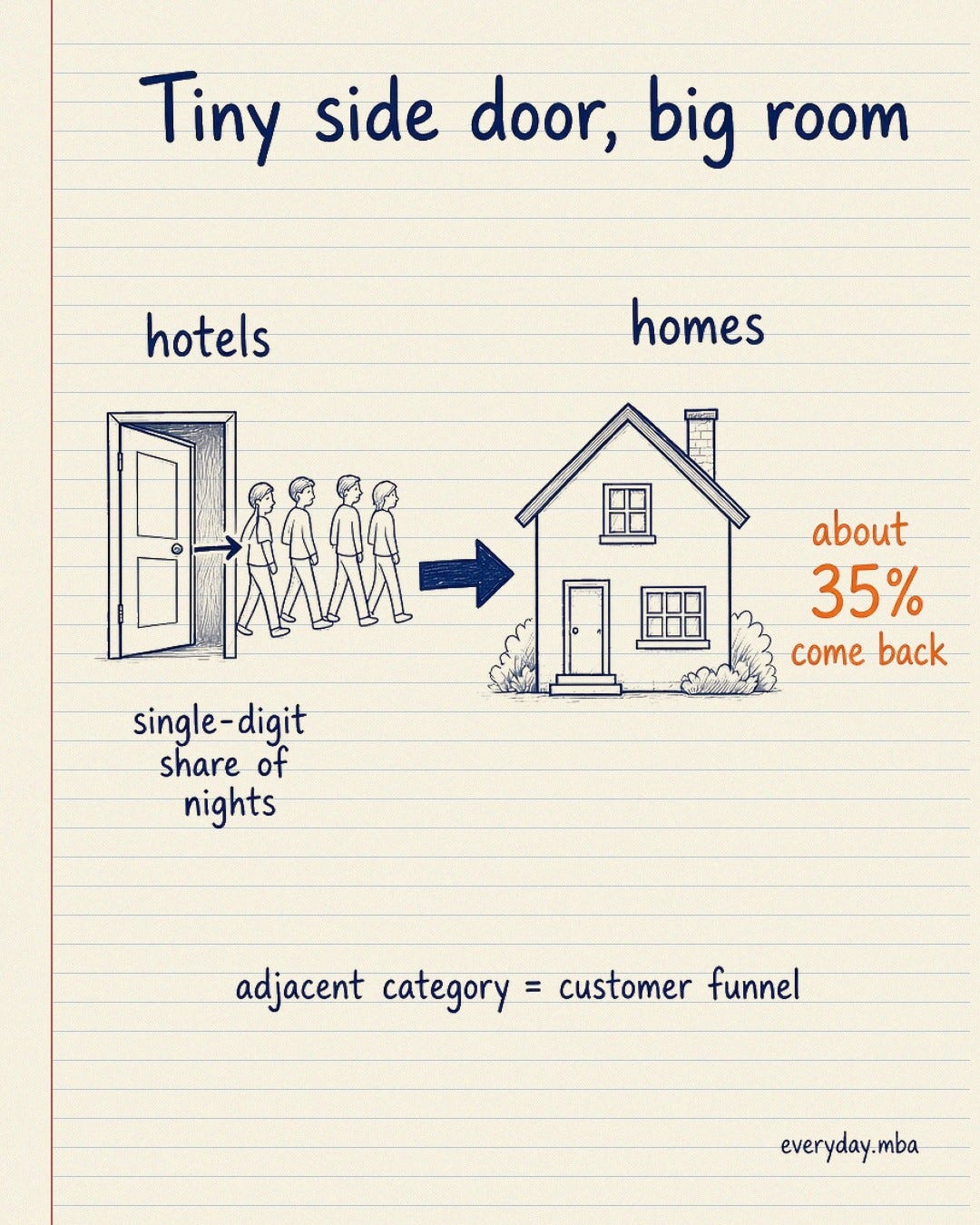
Airbnb’s real machine is homes. Hotels are still a single-digit slice of nights. If you only watch share of nights, hotels look like a rounding error.
But hotels do something homes alone may not do as well: they pull in new guests. Someone who has never stayed in a stranger’s house may be willing to book a boutique hotel on the same app. Once that guest trusts Airbnb for a trip, roughly one in three comes back and books a home, the category that already drives most of the platform.
That is an adjacent-category funnel. You add a product next to your core offer. It does not have to become the main business. Its job is to introduce customers who then buy the thing you already know how to sell.
Two checks keep this idea honest. First, the adjacent product has to be close enough that the customer still feels they are dealing with you. Hotels on Airbnb sit in the same search, payment, and support flow as homes. Second, you need evidence that people cross over. Airbnb published that crossover rate. Without it, “we added hotels” is just assortment, not acquisition.
Notice what this is not. It is not the claim that hotels will replace homes. Airbnb still says hotels are a single-digit share of nights. The point of the funnel is conversion into the core, not empire-building in the new line.
The same logic shows up outside travel. A software company launches a free or cheap starter tool so buyers discover the paid suite. A retailer puts a small brand next to the flagship so shoppers walk into the store. A bank offers a simple checking account that later feeds mortgages and wealth. In each case, the scoreboard for the side product is not only its own revenue. It is how many customers it hands to the main business.
Airbnb’s raised growth outlook is the backdrop. Product work, including hotels and other services, is part of how management explains the reacceleration. The funnel number is what makes the hotel push more than a press-release feature list.
How to Use It
1. Name the core. What product actually pays the bills today? Protect that before you chase adjacency.
2. Ask what the new line is for. Is it meant to become a second engine, or to feed customers into the first? Those goals need different metrics.
3. Track crossover, not just launch volume. Count how many new-line customers buy the core product within a set window, the way Airbnb tracked hotel-first guests who later booked a home.
4. Keep the path short. Same app, same checkout, same brand trust. The farther the hop, the weaker the funnel.
5. Watch share without panicking. A single-digit share can still be a win if the crossover rate is strong and the core keeps growing.
6. Use it at work. If you are adding a side offer, like a free tier, a starter SKU, or a partner channel, write one sentence: “This exists to bring customers to ___.” Then build the report that proves it.
Sources
1. Airbnb, “Airbnb Q3 2026 financial results,” newsroom, November 5, 2026. https://news.airbnb.com/airbnb-q3-2026-financial-results
2. Airbnb, Inc., Shareholder Letter (Exhibit 99.1 to Form 8-K), quarter ended September 30, 2026, filed November 5, 2026. https://www.sec.gov/Archives/edgar/data/1559720/000119312526449727/d437988dex991.htm
3. Investing.com (Reuters), “Airbnb rises on upbeat outlook, bucking broader industry caution,” November 6, 2026. https://www.investing.com/news/stock-market-news/airbnb-rises-on-upbeat-outlook-bucking-broader-industry-caution-5007328